Research & Development:
In its early stages, the institute focused on three key research areas: cancer research, family welfare programs, and malaria research. Several anti-cancerous principles have been isolated from medicinal plants, such as solamarine from Solanum trilobatum and plumbagin from Plumbago zeylanica.
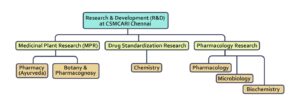
At present, the institute is actively engaged in Ayurvedic research in various disciplines across three broad areas – Medicinal Plant Research, Drug Standardization Research and Pharmacology Research. The focus is on the development and scientific validation of Ayurvedic formulations and single-plant-based medicines.
More than 600 research papers have been published in various national and international journals, 15 book chapters and about 154 scientific papers have been presented in various scientific seminars, conferences and symposia. The work carried out in CSMCARI has been included in the various publications of the Department of AYUSH and ICMR. Research activities confer various departments have been described below. The status of ongoing and completed projects (IMR/EMR) mentioned pertains to last 10 years.
Publication List           : Annexure V (Click to open)
4.1. Medicinal Plant Research
Medicinal Plant Research (MPR) at CSMCARI, Chennai, is executed by two departments – Botany/ Pharmacognosy and Pharmacy.
Department of Botany/ Pharmacognosy
Department of Botany/ Pharmacognosy conducts research and provides testing services in various areas related to the identification, authentication, and development of quality standards of medicinal plants and raw drugs used in Ayurveda.
To date, the department has contributed around 50 research publications in national and international journals and successfully completed seven intramural research projects. Four intramural research projects are currently ongoing, focusing on ethnobotany of Kolli and Pachamalai hills, and development of quality standards of drugs used in Ayurveda and traditional medicine. Monographs prepared by the department have been incorporated into the Ayurvedic Pharmacopoeia of India (API) and the Ayurvedic Formulary of India (AFI). The department has developed and published 15 powder monographs in API Part-I, Vol. VIII (2011), 8 Comprehensive Technical Dossiers on single drugs, 117 monographs for Quality Standards of Indian Medicinal Plants (published by ICMR). The department has also carried out studies on several compound formulations including Nimbadi Kwath Curna, Trikatu Curna, Sunthi Guggulu, Gomutra Haritaki, AYUSH-A, AYUSH-D, AYUSH Herbal Tea, and AYUSH M3.
The department also hosts an NABL-accredited laboratory which provides testing services under four parameters: macroscopic identification, sectional studies, powder microscopy, and taxonomic identification of Ayurvedic drugs. Since 2008, the department has been maintaining NABL Accreditation as per ISO/IEC 17025: 2017, adhering to NABL Standards. It is also recognized as a Drug Testing Laboratory (DTL) by the State Government of Tamil Nadu.
Captain Srinivasa Murthy Herbarium (CSMH), the regional herbarium under the department, which houses accessions dating back to 1960, is internationally indexed under Index Herbariorum of New York Botanical Garden, with the acronym “CSMH”. The department provides internships, training, and assistance for dissertations and research projects of post-graduate students. The department is equipped with sophisticated instruments, including High-Performance Liquid Chromatography (HPLC), High-Performance Thin Layer Chromatography (HPTLC), deep freezer (-80°C), a Trinocular compound microscope with CMOS camera and drawing tube attachment, a stereo zoom microscope and a flatbed herbarium scanner (1600 dpi).
Ongoing Projects
Completed Projects
1.       Development of Quality standards for Useful Parts of Selected Medicinal Plants of Ayurveda (IPS0033)
2.       Development and Digitalization of Authentic Ayurvedic Raw Drugs and Herbarium for the Medicinal Plants Appearing in Ayurvedic Formularies of India in Mandatory Drug Testing Laboratories of CCRAS. (IPS0027)
3.       Development of Quality Standards of Elsholtzia Species and assessment of Efficacy in Gastric Inflammatory Conditions  (CPS0002)
4.       Medico-Ethnobotanical Surveys in Kolli Malai and Pacha Malai and preparation of Monographs. (IBO0066)
 
 
1.       Developing Pharmacognostical Standards for some Ambiguous Ayurvedic Drugs (Sandigdha Dravyas) appearing in the Ayurvedic Formularies, Parts I to III. (IPS0013)
2.       Pharmacognostical Evaluation of Medicinal Plants cited in Ayurvedic Formulary of India excluding the plants mentioned in Ayurvedic Pharmacopoeia of India- Part –I
3.       Pharmacognostical Evaluation of Medicinal Plants cited in Ayurvedic Formulary of India excluding the plants mentioned in Ayurvedic Pharmacopoeia of India- Part –II. (IPS0014)
4.       Photographic Atlas on Macro-microscopic Characteristics of Medicinal Plants Listed in Ayurvedic Pharmacopoeia of India, Part-I, Volume – II. (IPS0019)
5.       Development of drug Master file and dossier on Fruits of Emblica officinalis (Farm: Phyllanthaceae) for Important Promising Medicinal Plants Based on Leads from Ayurveda & Contemporary Research. (IPS0027)
6.       Development of Quality Standards of Selected Extra-pharmacopoeial Drugs (Anukta Dravyas) Used in Local Health Traditions Collected from Different Regions of India. (IPS0028)
7.       Anthology of Pharmacognostical Research Outcomes of CCRAS on Selected Medicinal Plants of Ayurveda.
 
Department of Pharmacy/ Ayurveda
The pharmacy department of CSMCARI possesses a pharmacy section and a machinery room. This department is actively engaged in Developing Quality Standards for crude drugs and in developing Standard Operating Procedures for various Ayurvedic formulations. The pharmacy section is equipped with a Pill-making machine, a distillation unit, an End-runner mill, a fermentation vessel, a Tray drier, a Laboratory Blender, a Membrane filter with a vacuum pump, and a Capsule-filling machine. The machinery room is installed with Mini pulveriser (for making curnas), a disintegrator (for making kasayam powders) and a jaw-crusher (for disintegrating very hard plant parts like heart-wood, root and bark).
Ayurvedic drugs are mainly based on plants and plant-based products, besides animal products, metals/minerals and marine origin drugs (Sudha-varga drugs). In the Ayurvedic Drug manufacturing industry, there is a significant increase in information on Ayurvedic drugs and identification of constituents of drugs, parts used, method of preparation and standardisation of products. At the same time, new problems have also emerged in this sector, like non-availability of some of the constituent drugs, especially the root and bark of several plants., increase in demand of Ayurvedic drugs leading to substitution/adulteration, imposition of new laws to protect the environment as well as various plant species and formulations like Curnas (Powders), Bhasmas (metallic preparations), Asavas, Aristas (Alcoholic preparations), according to classical methods. Realising these problems in the supply of raw material, there is a need to facilitate the availability of raw drugs, which are authentic and contain the essential components as required under the Pharmacopoeial Standards. Keeping these facts in view since inception to 2023, the Pharmacy department is working in this research area and has taken up steps to develop Quality standards for plants, animals and mineral origin drugs and develop Standard Operating Procedures for processing to improve the quality of the final product.
The department is also concentrating on ethno-medicinal survey studies (2014-2017). Currently working on developing quality standards for extra-pharmacopeial drugs and Arka formulations and involved in organising medical camps at various places. The department is also acting as the facilitating centre to other departments of the institute, in selecting suitable drugs for research projects. So far, SOPs have been developed for 65 Ayurvedic formulations.
Ongoing Project
Completed Project
    1. Developing Quality Standards for selected Arka Formulations
 
1.       Ethno-medicinal Survey of Plants Used in Various Diseases by Tribe of Thandarai, Chengalpattu, Kancheepuram District, Tamilnadu
2.       Developing Quality Standards for selected Extra-pharmacopoeial drugs collected from Irula tribes of Thandarai, Kancheepuram District, Tamilnadu.
3.       Documentation of Life Profiles of Luminaries of Ayurveda – Vaidyaratna Captain G Srinivasa Murthy
4.       Documentation of Life Profiles of Luminaries of Ayurveda – Ms Savita Satakopan
5.       Documentation of Life profiles of Admirable Personalities to Transform Ayurveda (APTA)’- Padmashri Dr.V.Narayanaswamy.
6.       Documentation of Life Profiles of Luminaries of Ayurveda – Vaidyaratna N Rama Varier
7.       Documentation of Life profiles of Admirable Personalities to Transform Ayurveda (APTA)’- Aryavaidyan P V Raghava Varier
8.       Clinical evaluation of Ayurvedic Formulations Shatavari Guda and Triphala kashaya in Swethapradara (leucorrhoea)
9.       Establishment of Herbal Garden and Nursery centre at RARILSD, Poojapura, Thiruvananthapuram (NMPB-funded EMR project)
 
4.2. Drug Standardization Research
Drug Standardisation Unit was established in the year 1979 as a separate project for the Standardization of Siddha drugs. This was consequent to the bifurcation of Central Council for Research in Indian Medicine & Homeopathy into separate Councils in March 1978. Later this unit got merged with the Chemistry department of CSMCARI Chennai.
Department of Chemistry
The department comprises two sections: Analytical and Phytochemical. The Analytical section focuses on standardizing Ayurvedic drugs based on pharmacopoeial parameters. It has completed 446 formulations in Part I and Part II of the Ayurvedic Formulary of India. Standards for individual ingredients used in compound preparations are also being developed. The Phytochemical section investigates the chemistry of medicinal plants through extraction, fractionation, and isolation of known and novel compounds, followed by structural identification and biological screening. Notable bioactive compounds include Solamarine, Gangetin, Vicolides A–D, Physalin D, Arbortristosides A & B, Echitamine chloride, Plumbagin, Cryptanoside-A, Oleanolic acid D-glycoside, and Ruberythric acid. A key achievement is the isolation of an alkaloidal glucoside from Solanum trilobatum, patented and under commercial development for use as a cancer treatment adjuvant.
Since 2008, the department has been maintaining NABL Accreditation as per ISO/IEC 17025: 2017, adheres to NABL Standards. It is also recognized as a Drug Testing Laboratory by the State Government of Tamil Nadu to carry out the drug testing for industries/academic institutes/laboratories etc. In addition to sample testing, the department has been conducting cutting-edge research in the Indian system of medicine, especially, in Ayurvedic sciences. The department has equipped with sophisticated analytical instruments like GC-MS, ICP-OES, HPLC, HPTLC, AAS, Flash chromatography, Flame photometry, UV-Vis spectrophotometer, FT-IR, Rotary evaporator, milli-Q water system, Polarimeter, and other minor equipment. The Department mainly carries out preliminary phytochemical and physicochemical analysis, isolation of chemical markers and their elucidation, development of TLC/HPTLC fingerprint profile, estimation of markers and phytochemicals in single drug as well as compound formulation of herbal drugs, estimation of heavy metals, and identification of adulterants using analytical techniques.
Ongoing Project
Completed Project
1.       Development of quality standards & SOP with marker-based analysis and shelf-life study of four medicinally important classical ayurvedic formulations
2.       Isolation of Marker Compounds and Development of Marker Compound Library from four Selected Ayurvedic Medicinal Plants (Kancanara, Asthisrnkhala, Puskara & Lajjalu)
3.       Phytochemical investigation of hydro-alcoholic extractives with different ratios of selected Kvatha formulations
4.       Pharmaceutical Development and Standards for Formulation AYUSH-64 (Duration: 03 year, 2021-2024)
5.       Development of Quality Standards, Estimation of Markers, and Shelf-Life Study of Kvatha Curna Formulations (Duration: 03 years) 2023-2026
6.       Evaluation of Seasonal and Geographical Variation on Phytoconstituents/Marker Compounds in Selected Ayurvedic Medicinal Plants (Duration 02 years) 2023-2025.
7.       Comparative phytochemical evaluation of Ht.Wd. with small branches, leaf, and st.bark of common medicinal plants used in Ayurveda (Duration 02 years) 2024-2026.
8.       Nutritional profiling, Estimation of marker of Balya Drugs’’
9.       Development of Quality Standards of Selected Extra-Pharmacopoeial Drugs (AnuktaDravyas) used in Local Health Traditions collected from different regions of India.
10.    Development of Quality Standards, Estimation of Markers and Accelerated Shelf-Life Studies of Guducyadi, Caturbhadra and Amrtottara   Kvatha Curna Formulations.
11.    Isolation of Markers Compound from Ayurvedic Plants and Development of Marker Compound Library
1.       Estimation of Calcium and Trace minerals in Sudhavarga drugs of Ayurveda.
2.       Formulation of Drug Master File and Dossier for important promising medicinal plant Emblica officinalis (Phyllanthaceae) based on leads from Ayurveda and contemporary research
3.       Pharmacognostical Evaluation of Medicinal plants cited in Ayurvedic Formulary of India, Excluding the plants mentioned in API” Part-II”


4.3. Pharmacological Research
Pharmacological research at CSMCARI, Chennai, is executed by pharmacology, biochemistry and microbiology departments.
Department of Pharmacology
The Pharmacology department is specialized in conducting Pre-clinical toxicity and biological activity evaluation studies of various Ayurvedic formulations. The department has CCSEA (M/o Fisheries Animal Husbandry and Dairying, Government of India) approved Animal House Facility (Reg.No. 591/GO/Re/S/02/CPCSEA) with the total area of 4200 sq. ft. The Department is NABL Accredited as per ISO/IEC 17025:2017 for veterinary testing of hematology samples. Also recognised as a Drug Testing Laboratory by the State Government of Tamil Nadu to carry out the drug testing for industries/academic institutes/laboratories etc and also extending services to scholars and researchers. The lab is equipped with ELISA reader for immunology and hormonal assays, activity cage for excitatory and depressant activity, swimming test apparatus for inducing stress and stress induced ulcerogenic potential studies, metabolic cages for measuring feed and water intake, urine and faecal matter collector, diuretic activity testing, Y maze, plus maze for nootropic activity, histamine chamber for anti-asthmatic activity, veterinary haematology analyser, UV spectrophotometer, Stereo zoom microscope, ECG monitoring, power lab with lab chart software, millar catheter for invasive blood pressure monitoring, CODA monitor for NIBP, Arc HPLC with Empower3 software and nitrogen evaporator for pharmacokinetic studies. In Histopathology facility, the instruments like microtome, hot air oven, incubator are present. The Animal house Facility has a barrier system under CCTV monitoring which contains clean and service corridors equipped with air shower, pass boxes, air handling units, Industrial size Autoclave, RO water facility, UV room for surface sterilization.  Isoflurane anaesthesia system is available for small animal procedures and carbon dioxide chamber for animal sacrifice. The Department have MoU with Tamil Nadu Biomedical Waste Management System for biological waste disposal. The department carries out work under Council allotted projects; CCRAS Intramural Research Projects which includes pre-clinical toxicity screening following OECD as well as CCRAS guideline along with other appropriate guidelines such as ICH, EMA etc., and efficacy studies, Collaborative projects with CSIR-IITR Lucknow, ICMR- NIN Hyderabad and many Ph. D. Projects. The department has published several papers in indexed and other reputed journals; received many awards, medals and participated in Oral and Poster presentations in National and International Conferences, Seminars/workshop and scientific meetings as invited and lead speakers. This Institute is affiliated with University of Madras, produced one PhD and currently two scholars are pursuing Ph D in the Department. The staff worked on Ayurvedic formulations such as Parpati, Churna, Vati, Lehya, Bhasma, Guggulu, Extracts, External applications, Single drugs and Eye drops.  The department has expertise on animal models like Asthma, Arthritis, Nephropathy, Migraine, Anti-inflammatory, Ocular testing, Surgical model of stroke and Obesity.
Ongoing Projects
Completed Projects
1.          Cardioprotective Effect of Pushkara Guggulu on Experimentally Induced Myocardial Infarction in Rats, instruments purchased, order placed for procurement of animals.
2.          Development of Madhuca longifolia (Flower) based food recipe (Product development) and its nutritional,toxicity, efficacy and bioavailability studies
3.          Toxicity profile of Tribhuvana Kirti Rasa in experimental animals.
4.          Development of Opuntia elatior (fruit) based food recipes (product development) and its             nutritional, toxicity, efficacy and bioavailability studies   
5.          Acute and chronic (180 days) oral toxicity study of coded drug AYUSH RP
6.          Acute and Chronic (180 days) repeated dose oral toxicity study of Nimbatitkam
7.          Acute and 180-days repeated dose oral toxicity study of Ayush Balrakshak Lehyam
1.       Effect of Haritkadi yoga on middle cerebral artery occlusion ischemic-reperfusion injury and its safety in rats.
2.       Acute and 90 days repeated dose oral toxicity study of Coded drug AYUSH-PK Avaleha
3.       Acute and 90 days repeated dose oral toxicity study of Coded drug AYUSH-SDM.
4.       Development of Drug Master file and Dossier on fruit of Emblica officinalis for promising medicinal plants based on leads for Ayurveda and contemporary research. Pharmacology part.
5.       Evaluation of Sveta Parpati for its curative and preventive action in Urolithiasis experimental study in rats.
6.       Preclinical Evaluation (Toxicity and efficacy profile) of an Ayurvedic herbal formulation Vaisvanara Churna used in the treatment of Rheumatoid arthritis.
7.       Acute and 90 days repeated dose oral toxicity study of Coded drug AYUSH-HR
8.       In vitro and in vivo nephro protective evaluation of AYUSH K1 extract. 
9.       In-vitro and in-vivo evaluation of anti-migraine activity of AYUSH-M3.
10.    Safety and anti-obesity activity of Tryusanadi guggulu in experimental animals.
 
Department of Biochemistry
Department of Biochemistry was established in 1967. Currently, it is housed on the first floor of the Captain Srinivasa Murthy Central Ayurveda Research Institute, Arumbakkam, Chennai. This department has been accredited with NABL since 2008 with ISO/IEC 17025:2005 and upgraded to ISO/IEC 17025:2017 and strictly follows the NABL norms for quality assurance. This department has good instrumentation facilities. The instruments with periodic maintenance and quality control checks are done regularly to ensure the quality of test results.  The department analyses the biochemical aspects of Council allotted safety and efficacy studies and Intra Mural Research projects. This department participates in proficiency testing programs and intra-laboratory comparisons to maintain quality standards. This laboratory is an approved Drug Testing Laboratory for herbal drug analysis by the State Licensing Authority, Indian Systems of Medicine, Government of Tamil Nadu. The deparment supports the postgraduate students for their thesis research work. Several papers have been presented in conferences/seminars and several research articles have been published in well-reputed journals. Besides this, Hands-on training on sophisticated instruments and summer training is regularly provided to undergraduate and postgraduate students from various academic and research institutes. The department was equipped with sophisticated instruments like Clinical chemistry auto analyzer, RT-PCR, Gel Documentation Unit, Western Blot, UV-Visible spectrophotometer, Semi auto analyzer, Tissue homogenizer, Cooling Microcentrifuge, Deep freezer (-20°C), Electrophoresis units, pH meter, Micro centrifuges, Digital Hot top with magnetic stirrer and other accessory instruments.
Ongoing Project
Completed Project
Anti-cancer activity of Chaulmoogra oil and Shwetha Sarshapa churna in the treatment of epidermal carcinoma of skin in experimental mice.
1.       A biochemical role of AYUSH-PTK, an Ayurvedic formulation against anti-tubercular drug-induced hepatotoxicity in rats (2020-2022)
2.       Anti-atherosclerotic activity of Hirdayarnava rasa on animal model (2018-2020)
3.       Biochemical studies on Premna integrifolia Linn. in high-fat diet-induced atherosclerosis model rats (2014-2016)
Department of Microbiology
The Department of Microbiology at CSMCARI, Chennai, is an NABL-accredited testing laboratory as per ISO/IEC 17025:2017. Routine testing of AYUSH products and DTL samples are conducted in the department in accordance with API guidelines. Along with research activities involving IMR projects.  More than 100 Ayush products/samples are being tested in each financial year under IMR projects, and dissertation training/short-duration training is also being provided to the students. The department is equipped with a BSL-2 facility along with various instruments for research activities such as pH meter, Autoclave Bacteriological and BOD Incubators, colony counter, UV-Chamber, Microplate reader, cooling centrifuge, Trinocular Microscope, Cyclomixer, Magnetic stirrer, refrigerator, -40℃ deep freezer and other supporting instruments.
Ongoing Project
Completed Project
1.       Isolation and Identification of Endophytic Microorganisms from the stem barks used in Ayurveda (Panchavalkala) and Evaluation of their Antimicrobial, antioxidant and antibiofilm activities
 
1.       Antibacterial Activity of selective Ayurveda formulations against Gastrointestinal infection, Respiratory infection and Urinary Tract infection-causing bacteria
Department of Botany/ Pharmacognosy
  1. Development of a Rapid and Cost-Effective Primer-Based Tool for Correct Species Determination of Some Commonly Traded Herbal Drugs (IBO0080).

Department of Chemistry

 
  1. Ghosh K, Krishna KV, Vinodkumar T, Dinesh T, Balakumar R, Chitra S. Mineral composition of Aegle marmelos (L.) corrêa ash: Exploration of its ability to mimic the function of different metalloenzymes. Chemistry of Inorganic Materials. 2024 Dec 1; 4:100074. DOI: 10.1016/j.cinorg.2024.100074. ISSN: 2949-9175.
  2. Ghosh K, Saravanan M, Vamsee Krishna K, Vinodkumar T, Balakumar R, Ilavarasan R, Mandal AK, Ramachandran S. Exploration of catalytic activities of Caesalpinia bonduc (L.) Roxb. ash on green-oxidation of small organic substrates: an effective way to reduce the use of harsh chemicals. Discover Chemistry. 2024 Oct 7;1(1):26. DOI: https://doi.org/10.1007/s44321-024-00026-0. ISSN: 3005-4836.
  3. Ghosh K, Vinodkumar T, Singh R, Singh A, Ilavarasan R. Promising potential of millets as the staple of our plate: An Indian perspective. Discover Food. 2024 Oct 7;4(1):103. DOI: https://doi.org/10.1007/s44187-024-00176-7. ISSN: 2731-4286.
  4. Ghosh K, Saravanan M, Balakumar R, Kumar TV, Ilavarasan R, Mandal AK, Ramachandran S. Eco-Friendly Synthesis of Alstonia scholaris (L.) R. Br. Extract-Mediated Nanostructured Material: Removal of Organic Pollutants from Water Resources. Waste Management Bulletin. 2024 Apr 1;2(1):299-305. DOI: https://doi.org/10.1016/j.wmb.2024.02.005. ISSN: 2949-7507.
  5. Dastidar TG, Ghosh K, Drew MGB, Gomila RM, Frontera A, Chattopadhyay S. Estimation of the ability of the π-system of pseudohalides (azide and thiocyanate) to participate in CH···π interactions in cyclic hetero-tetranuclear cobalt (III)/sodium and… Polyhedron. 2022;222:115862. DOI: https://doi.org/10.1016/j.poly.2022.115862. ISSN: 0277-5387.
  6. Mondal I, Ghosh K, Franconetti A, Frontera A, Chatterjee S, Chattopadhyay S. Synthesis and characterization of a manganese (III) schiff base complex and exploration of Br··· Br interaction in the solid state structure of the complex. Journal of Coordination Chemistry. 2019 Nov 2;72(19-21):3237-47. DOI: 10.1080/00958972.2019.1688311. ISSN: 0095-8972.
  7. Dastidar TG, Ghosh K, Drew MGB, Chattopadhyay S. A combined experimental and theoretical study on an ionic cobalt (III/II) complex with a Schiff base ligand. New J Chem. 2022;46(16):7590-603. DOI: https://doi.org/10.1039/D2NJ00421G. ISSN: 1144-0546 (Print); 1369-9261 (Online).
  8. Bhaumik PK, Ghosh K, Chattopadhyay S. Synthetic strategies, crystal structures and biological activities of metal complexes with the members of azole family: A review. Polyhedron. 2021; 200:115093. DOI: https://doi.org/10.1016/j.poly.2021.115093. ISSN: 0277-5387.
  9. Ghosh K, Frontera A, Chattopadhyay S. A theoretical insight on the anion⋯anion interactions observed in the solid-state structure of a hetero-trinuclear complex. CrystEngComm. 2021;23(6):1429-38. DOI: https://doi.org/10.1039/D0CE01761C. ISSN: 1466-8033
  10. Ghosh K, Banerjee S, Chattopadhyay S. Relative stability of the cis and trans isomers of octahedral cobalt (iii) complexes of the type [Co (N₂O₂) X₂] with tetradentate salen type Schiff bases: a combined… CrystEngComm. 2019;21(40):6026-37. DOI: https://doi.org/10.1039/C9CE01087F. ISSN: 1466-8033.
  11. Ghosh K, Sil S, Ray PP, Ortega-Castro J, Frontera A, Chattopadhyay S. Photosensitive Schottky barrier diode behavior of a semiconducting Co (III)–Na complex with a compartmental Schiff base ligand. RSC Adv. 2019;9(60):34710-9. DOI: https://doi.org/10.1039/C9RA07233G. ISSN: 2046-2069.
  12. Ghosh K, Harms K, Franconetti A, Frontera A, Chattopadhyay S. A triple alkoxo bridged dinuclear cobalt (III) complex mimicking phosphatase and showing ability to degrade organic dye contaminants by photocatalysis. J Organomet Chem. 2019;883:52-64. DOI: https://doi.org/10.1016/j.jorganchem.2019.01.011. ISSN: 0022-328X.
  13. Ghosh K, Chattopadhyay S. Synthetic stratagem and structures of two heteroleptic cobalt (III) complexes acting as biomimetic catalysts: Role of co-ligands in catalytic activities. Polyhedron. 2019;170:495-507. DOI: https://doi.org/10.1016/j.poly.2019.06.018. ISSN: 0277-5387.
  14. Mondal I, Ghosh K, Chattopadhyay S. Synthesis and structural characterization of three manganese (III) complexes with N₂O₂ donor tetradentate Schiff base ligands: exploration of their catalase mimicking activity. Inorg Chim Acta. 2019;494:123-31. DOI: https://doi.org/10.1016/j.ica.2019.05.016. ISSN: 0020-1693.
  15. Sarkar N, Ghosh K, Gonzalez-Prieto R, Herrero S, Chattopadhyay S. Construction of a new double phenoxo bridged asymmetric manganese (III) Schiff base complex: Observation of ferromagnetic interaction within the dimer and antiferromagnetic. Polyhedron. 2019;164:138-45. DOI: https://doi.org/10.1016/j.poly.2019.02.041. ISSN: 0277-5387.
  16. Ghosh K, Harms K, Bauzá A, Frontera A, Chattopadhyay S. σ-Hole halogen bonding interactions in a mixed valence cobalt (III/II) complex and anti-electrostatic hydrogen bonding interaction in a cobalt (III) complex: a theoretical insight. CrystEngComm. 2018;20(45):7281-92. DOI: https://doi.org/10.1039/C8CE01323C. ISSN: 1466-8033.
  17. Ghosh K, Harms K, Bauzá A, Frontera A, Chattopadhyay S. Heteronuclear cobalt (iii)/sodium complexes with salen type compartmental Schiff base ligands: methylene spacer regulated variation in nuclearity. Dalton Transactions. 2018;47(2):331-47. DOI: https://doi.org/10.1039/C7DT03929H. ISSN: 1477-9234.
  18. Ghosh K, Harms K, Chattopadhyay S. Two cobalt (III) Schiff base complexes of the type [Co (ABC)(DE) X]: Facile Synthesis, characterization, catechol oxidase and phenoxazinone synthase mimicking activity. ChemistrySelect. 2017 Sep 21;2(27):8207-20. DOI: https://doi.org/10.1002/slct.201701536. ISSN: 2365-6549.
  19. Ghosh K, Harms K, Chattopadhyay S. Synthesis, characterization and phenoxazinone synthase mimicking activity of cobalt (III) Schiff base complexes. Polyhedron. 2017 Feb 17;123:162-75. DOI: https://doi.org/10.1016/j.poly.2016.10.027. ISSN: 0277-5387.
  20. Ghosh K, Banerjee A, Roy S, Bauzá A, Frontera A, Chattopadhyay S. A combined experimental and theoretical study on supramolecular assemblies in octahedral cobalt (III) salicylaldimine complexes having pendant side arms. Polyhedron. 2016 Jul 7;112:86-95. DOI: https://doi.org/10.1016/j.poly.2016.03.008. ISSN: 0277-5387.
 
  1. Ghosh K, Roy S, Ghosh A, Banerjee A, Bauzá A, Frontera A, Chattopadhyay S. Three mononuclear octahedral cobalt (III) complexes with salicylaldimine Schiff bases: Synthesis, characterization, phenoxazinone synthase mimicking activity and DFT study on supramolecular interactions. Polyhedron. 2016 Jul 7;112:6-17. DOI: https://doi.org/10.1016/j.poly.2016.02.035. ISSN: 0277-5387.
  2. Vinodkumar T, Dinesh T, Ghosh K, Ilavarsan, R.A comprehensive analysis of minerals in Moringa oleifera leaves, seeds, stem bark, and ash using inductively coupled plasma-optical emission spectroscopy (ICP-OES).  Chem. 2, 36 (2025). https://doi.org/10.1007/s44371-025-00115-0. Electronic ISSN: 3005-1193
  3. Vinodkumar T, Narasimhaji CV, Kumar CP, Kusuma G, Swamy CT, Rao VR, Marimuthu G, Naresh V, Ghosh K, Ilavarasan R, Singh R. Standardization of AYUSH-64 a Poly Herbal Formulation: Phyto-Pharmacognostical Evaluation and Estimation of Picroside-I and Picroside-II using HPLC. Revista Brasileira de Farmacognosia. 2025 Apr;35(2):345-52, https://doi.org/10.1007/s43450-025-00618-y. Electronic ISSN: 1981-528X
  4. Varkolu M, Gundekari S, Omvesh, Palla VC, Kumar P, Bhattacharjee S, Vinodkumar T. Recent advances in biochar production, characterization, and environmental applications. Catalysts. 2025 Mar4;15(3):243,  https://doi.org/10.3390/catal15030243. ISSN: 2073-4344
  5. Vinodkumar T, Kumar JP, Reddy BM. Supported nano-sized Ce0. 8Eu0. 2O2-δ solid solution catalysts for diesel soot and benzylamine oxidations. Journal of Chemical Sciences. 2021 Sep;133(3):68. https://doi.org/10.1007/s12039-021-01938-x. Electronic ISSN: 0973-7103
  6. Kumar KA, Vinodkumar T, Selvaraj M, Suryakala D, Subrahmanyam C. Visible light-induced catalytic abatement of 4-nitrophenol and Rhodamine B using ZnO/g-C3N4 catalyst. Journal of Chemical Sciences. 2021 Jun;133(2):41. https://doi.org/10.1007/s12039-021-01903-8. Electronic ISSN: 0973-7103
  7. Lakshminarayana B, Vinodkumar T, Satyanarayana G, Subrahmanyam C. Novel ultra-small Pd NPs on SOS spheres: a new catalyst for domino intramolecular Heck and intermolecular Sonogashira couplings. RSC advances. 2020;10(8):4568-78. DOI: 1039/C9RA09429F. ISSN:2046-2069
  8. Chawdhury P, Ray D, Vinodkumar T, Subrahmanyam C. Catalytic DBD plasma approach for methane partial oxidation to methanol under ambient conditions. Catalysis Today. 2019 Oct 15;337:117-25. https://doi.org/10.1016/j.cattod.2019.03.032. Print ISSN: 0920-5861
  9. Ray D, Nepak D, Vinodkumar T, Subrahmanyam C. g-C3N4 promoted DBD plasma assisted dry reforming of methane. Energy. 2019 Sep 15;183:630-8. https://doi.org/10.1016/j.energy.2019.06.147. ISSN: 0360-5442
  10. Kumar KA, Lakshminarayana B, Vinodkumar T, Subrahmanyam C. Cu-ZnO for visible light induced mineralization of Bisphenol-A: Impact of Cu ion doping. Journal of Environmental Chemical Engineering. 2019 Jun 1;7(3):103057. https://doi.org/10.1016/j.jece.2019.103057. ISSN: 2213-3437
 
  1. Subramanyam P, Vinodkumar T, Nepak D, Deepa M, Subrahmanyam C. Mo-doped BiVO4@ reduced graphene oxide composite as an efficient photoanode for photoelectrochemical water splitting. Catalysis Today. 2019 Mar 15;325:73-80. https://doi.org/10.1016/j.cattod.2018.07.006. Print ISSN: 0920-5861
  2. Vinodkumar T, Subramanyam P, Kumar KA, Reddy BM, Subrahmanyam CH. Construction of metal oxide decorated gC3 N4 materials with enhanced photocatalytic performance under visible light irradiation. Journal of Chemical Sciences. 2019 Feb;131(2):13. https://doi.org/10.1007/s12039-018-1588-z. Electronic ISSN: 0973-7103
  3. Subramanyam P, Vinodkumar T, Deepa M, Subrahmanyam C. Gold nanoparticle decorated bismuth sulfide nanorods for enhanced photoelectrochemical hydrogen production. Journal of Materials Chemistry C. 2019;7(21):6398-405. https://doi.org/10.1039/C9TC00759H. ISSN 2050-7534.
  4. Mukherjee D, Devaiah D, Venkataswamy P, Vinodkumar T, Smirniotis PG, Reddy BM. Superior catalytic performance of a CoO x/Sn–CeO 2 hybrid material for catalytic diesel soot oxidation. New Journal of Chemistry. 2018;42(17):14149-56. https://doi.org/10.1039/C8NJ01184B. ISSN: 1369-9261
  5. Vinodkumar T, Mukherjee D, Subrahmanyam C, Reddy BM. Investigation on the physicochemical properties of Ce 0.8 Eu 0.1 M 0.1 O 2− δ (M= Zr, Hf, La, and Sm) solid solutions towards soot combustion. New Journal of Chemistry. 2018;42(7):5276-83. https://doi.org/10.1039/C8NJ00007G. ISSN: 1369-9261
  6. Kumar PS, Suresh L, Vinodkumar T, Chandramouli GV. Eu2 O3 modified CeO2 nanoparticles as a heterogeneous catalyst for an efficient green multicomponent synthesis of novel phenyldiazenyl-acridinedione-carboxylic acid derivatives in aqueous medium. RSC Advances. 2016;6(94):91133-40. https://doi.org/10.1039/C6RA17990H. ISSN:2046-2069
  7. Suresh L, Kumar PS, Vinodkumar T, Chandramouli GV. Heterogeneous recyclable nano-CeO 2 catalyst: efficient and eco-friendly synthesis of novel fused triazolo and tetrazolo pyrimidine derivatives in aqueous medium. RSC advances. 2016;6(73):68788-97. https://doi.org/10.1039/C6RA16307F. ISSN:2046-2069.
  8. Reddy BM, Vinodkumar T, Naga Durgasri D, Rangaswamy A. Synthesis and characterization of nanostructured Ce0. 8M0. 2O2− δ (M= Sm, Eu, and Gd) solid solutions for catalytic CO oxidation. Proceedings of the National Academy of Sciences, India Section A: Physical Sciences. 2017 Mar;87(1):155-61. https://doi.org/10.1007/s40010-016-0282-0. Electronic ISSN: 2250-1762.
  9. Sagar Vijay Kumar P, Suresh L, Vinodkumar T, Reddy BM, Chandramouli GV. Zirconium doped ceria nanoparticles: an efficient and reusable catalyst for a green multicomponent synthesis of novel Phenyldiazenyl–chromene derivatives using aqueous medium. ACS Sustainable Chemistry & Engineering. 2016 Apr 4;4(4):2376-86. https://doi.org/10.1021/acssuschemeng.6b00056. ISSN 2168-0485
  10. Vinodkumar T, Rao BG, Reddy BM. Influence of isovalent and aliovalent dopants on the reactivity of cerium oxide for catalytic applications. Catalysis Today. 2015 Sep 15;253:57-64. https://doi.org/10.1016/j.cattod.2015.01.044. Print ISSN: 0920-5861
 
  1. Vinodkumar T, Durgasri DN, Maloth S, Reddy BM. Tuning the structural and catalytic properties of ceria by doping with Zr4+, La3+ and Eu3+ cations. Journal of Chemical Sciences. 2015 Jul;127(7):1145-53. https://doi.org/10.1007/s12039-015-0891-1. Electronic ISSN: 0973-7103.
  2. Lin F, Delmelle R, Vinodkumar T, Reddy BM, Wokaun A, Alxneit I. Correlation between the structural characteristics, oxygen storage capacities and catalytic activities of dual-phase Zn-modified ceria nanocrystals. Catalysis Science & Technology. 2015;5(7):3556-67. 1039/C5CY00351B. ISSN: 2044-4761
  3. Vinodkumar T, Naga Durgasri D, Reddy BM, Alxneit I. Synthesis and structural characterization of Eu2O3 doped CeO2: influence of oxygen defects on CO oxidation. Catalysis letters. 2014 Dec;144(12):2033-42. https://doi.org/10.1007/s10562-014-1367-5. Electronic ISSN: 1572-879X.
  4. Durgasri DN, Vinodkumar T, Lin F, Alxneit I, Reddy BM. Gadolinium doped cerium oxide for soot oxidation: Influence of interfacial metal–support interactions. Applied surface science. 2014 Sep 30;314:592-8. https://doi.org/10.1016/j.apsusc.2014.07.036. ISSN: 1873-5584.
  5. Durgasri DN, Vinodkumar T, Sudarsanam P, Reddy BM. Nanosized CeO2–Gd2O3 mixed oxides: study of structural characterization and catalytic CO oxidation activity. Catalysis letters. 2014 Jun;144(6):971-9.https://doi.org/10.1007/s10562-014-1223-7. Electronic ISSN: 1572-879X
  6. Durgasri DN, Vinodkumar T, Reddy BM. Facile synthesis of catalytically active CeO2–Gd2 O 3 solid solutions for soot oxidation. Journal of Chemical Sciences. 2014 Mar;126(2):429-35. https://doi.org/10.1007/s12039-014-0581-4. Electronic ISSN: 0973-7103.
  7. Vinodkumar T, Naga Durgasri D, Reddy BM. Design of transition and rare earth metal doped ceria nanocomposite oxides for CO oxidation. International Journal of Advances in Engineering Sciences and Applied Mathematics. 2013 Dec;5(4):224-31. https://doi.org/10.1007/s12572-013-0100-8. Electronic ISSN: 0975-5616
  8. Reddy BM, Kumar TV, Durgasri N. New Developments in Ceria Based Mixed Oxide Synthesis and Reactivity in Combustion and Oxidation Reactions. In Catalysis by ceria and related materials 2013 Apr 30 (pp. 397-459). London: Imperial College Press.
  9. Katta L, Kumar TV, Durgasri DN, Reddy BM. Nanosized Ce1− xLaxO2− δ/Al2O3 solid solutions for CO oxidation: Combined study of structural characteristics and catalytic evaluation. Catalysis Today. 2012 Dec 30;198(1):133-9. https://doi.org/10.1016/j.cattod.2012.07.015. Print ISSN: 0920-5861
  10. Reddy BM, Durgasri N, Kumar TV, Bhargava SK. Abatement of gas-phase mercury—recent developments. Catalysis Reviews. 2012 Jul 1;54(3):344-98.https://doi.org/10.1080/01614940.2012.650966. Print ISSN: 0161-4940.
  11. Vinodkumar T, Reddy BM. Catalytic combustion over cheaper metal oxides. Chapter. 2011:3. ISBN: 978-1-61324-279-7.
  12. Vinodkumar T, Ghosh K, Ilavarasan R. Phytochemical Characterization of Plants In Futuristic Trends in Herbal Medicines and Food Products, IIP Series, 2024, 123-135, ISBN: 978-93-5747-680-5.
 
  1. Shubhashree MN, Shantha TR, Ramarao V, Reddy MP, Venkateshwaraul G. A review on therapeutic uses of flowers as depicted in classical texts of Ayurveda and Siddha. J. Res. Educ. Indian Med. 2015 Jan;21(1):1-4. ISSN: 0970-7700.
  2. Bharthi V, Kavya B, Shantha TR, Prathapa Reddy M, Kavya N, Rama Rao V, Kalpeshkumar BI, Venkateshwarlu G. Pharmacognostical evaluation and phytochemical studies on Ayurvedic nutritional fruits of Trapa natans L. Int J Herb Med. 2015;3(5):13-19. ISSN (O): 2321-2187.
  3. Shantha TR, Patchaimal P, Reddy MP, Kumar RK, Tewari D, Bharti V, Venkateshwarlu G, Mangal AK, Padhi MM, Dhiman KS. Pharmacognostical standardization of Upodika-Basella alba L.: an important ayurvedic antidiabetic plant. Ancient Science of life. 2016 Jul 1;36(1):35-41. doi: 10.4103/0257-7941.195411. ISSN: 0257-7941.
  4. Reddy MP, Kavya B, Rao VR, Shantha TR, Kumar RK, Venkateshwarlu G, Rahmathulla R. Therapeutic uses of flowers-leads from traditional system of medicine. Int J Herb Med. 2015;3(3):12-20. ISSN (O): 2321-2187.
  5. Reddy MP, Shantha TR, Rao VR, Venkateshwarlu G. Pharmacognostical and Physicochemical Evaluation on the Flowers of Justicia adhatoda L. Research Journal of Pharmacognosy and Phytochemistry. 2015;7(2):73-90. DOI: 10.5958/0975-4385.2015.00014.X. Electronic ISSN: 0975-4385.
  6. Ramaseshan ST, Pitchaiah P, Bharti V, Ramakrishna KK, Gaddam V, Tewari D, Rath C, Mangal A, Mohan PM, Singh DK. Pharmacognostical, Phytochemical and Nutritional Evaluation of Glinus oppositifolius (L.) Aug. DC. Pharmacognosy Journal. 2016;8(1): 31-36. DOI: 5530/pj.2016.1.7. ISSN: 0975-3575.
  7. Reddy MP, Shantha TR, Bharathi V, Kumar RK, Venkateshwarlu G. Pharmacognostical evaluation on the Medicinal & Nutritive fruits of Raamaphal–Annona reticulata Journal of Pharmacognosy and Phytochemistry. 2015 May 1; 4(1): 21-28. Electronic ISSN: 2278-4136.
  8. Giri SK, Sangamitra P, Kishore Kumar R, M Prathapa Reddy, G Venkateshwarlu. Potential Of Ayurvedic Panchakarma in Prevention and Management of Lifestyle Disorders with Special Reference to Madhumeha.  Journal of Ayurveda and Holistic Medicine (JAHM), 2015; 3(5): 82-91. https://doi.org/10.70066/jahm.v3i5.87. Print ISSN: 2321-1563.
  9. Prathapa Reddy M, Shantha T, Naveen Kumar S, Rama Rao V, Shiddamallayya N, Dixit AK. Pharmacognostical studies on fruits of Babbula–Acacia nilotica (L.) Delile. J. Herb. Med. 2018; 6 (2):115-120. Electronic ISSN: 2321-2187.
  10. Shantha TR, Shubhashree MN, Reddy MP, Venkateshwarlu G. Pharmacognostic and Physicochemical Evaluation of the Different Varieties of Sesamum indicum–A Comparative Study. Research Journal of Pharmacognosy and Phytochemistry. 2014;6(2):99-106. Electronic ISSN: 0975-4385.
  11. Bharthi V, Reddy P, Tr S, Venkateshwarlu G. Phytochemical evaluation and powder microscopy of medicinal and nutritional fruits of Physalis peruviana International Journal of Herbal Medicine. 2016;4(1):43-46. Electronic ISSN: 2321-2187.
 
  1. TR Shantha, Prathapa Reddy M, Vendrapati R, Ramakrishna K K, Bhat S. Pharmacognostical studies on the leaves of lakshmitaru (Simarouba glauca), a well-known anti-cancerous plant. World J Pharm Pharm Sci. 2016. 5(9): 1717-1727. ISSN: 2278-4357.
  2. Prathapa Reddy M, Rama Rao V, Shantha TR, Kishore Kumar R, Shiddamallayya N. Sulochana Bhat. Phytochemical analysis and thin layer chromatography of Clausena dentata. World J Pharm Pharm Sci 2016; 5 (9):1706-1716. ISSN: 2278-4357.
  3. Venkateshwarlu G, Venkata NC, Shantha TR, Kishore KR, Prathapa RM, Raghavendra HL. A comparative physicochemical and pharmacognostical evaluation of Nishamalaki-an ayurvedic antidiabetic formulation. Science, Technology and Arts Research Journal. 2013 Dec 17;2(3):69-78. Electronic ISSN: 2305-3327.
  4. Prathapa RM, Shantha TR, Rao VR, Shiddamallayya N, Bharali BK. Pharmacognostical standardization of Vanasarpagandha (Rauvolfia tetraphylla) root. Int. J. Herbal Med. 2020;8(6):12-14. Electronic ISSN: 2321-2187.
  5. Prathapa Reddy M, Shantha TR, Bhat S. Pharmacognostical Studies on Medicinal and Nutritional Seeds of Jack Fruit: Artocarpus Heterophyllus Int J Pharmacognosy 2016; 3(9): 384-391. Electronic ISSN:2348-3962.
  6. Reddy MP, Ramaseshan ST, Parvatamma NK, Rao VR, Nagayya S, Bhat S. Pharmacognostical Evaluation of Arjuna Flowers: Terminalia Arjuna (Roxb.) Wight & Arn. Journal of Drug Research in Ayurvedic Sciences. 2017 Oct 1;2(4):289-94. DOI: 5005/jp-journals-10059-0025. Electronic ISSN: 2581-8295.
  7. Reddy MP, Shantha TR, Rao VR, Shiddamallayya N, Dixit AK. Pharmacognostical standardization on the roots of Agnimantha – Premna serratifolia International Jounral of Pharmacognosy 2018;5(7):426-430. Electronic ISSN:2348-3962.
  8. Shantha TR, Prathapa Reddy M, Rama Rao V, Shiddamallayya N, Sulochana Bhat. Pharmacognostical Standardization of stem bark of Saptachakra – Salacia chinensis World J Pharm Pharm Sci 2021; 10 (5):1173-1183. ISSN: 2278-4357.
  9. Prathapa Reddy, TR Shantha, Sulochana Bhat. Pharmacognostical studies on the fruits of Vanya Ajamoda – Trachyspermum roxburghianum (Dc.) H. Wolff. Int. J. Herb. Med. 2018; 6 (6):122-126. Electronic ISSN: 2321-2187.
  10. Mangal AK, Shantha TR, Patchaimal P, Tewari D, Reddy MP, Kumar RK, Bharti V, Venkateshwarlu G, Srikanth N, Dhiman KS. Nutritive investigation of plants used in dietetics: with special reference to Yoga. Indian Journal of Traditional Knowledge. Vol. 16(Suppl), June 2017, pp. S 53-S 59. Electronic ISSN: 0975-1068.
  11. Shantha T. R., Prathapa Reddy M., Rama Rao V., Vandana Bharati, Kishore Kumar R., Venkateshwarlu G. Pharmacognostic and Priliminary phytochemical studies on the flowers of Kovidara: Bauhinia purpurea Journal of Drug Research in Ayurveda and Siddha 2015; 1(1):47-60. Electronic ISSN: 2581-8295.
  12. G Ramu, TR Shantha, G Krishna Mohan, M Prathapa Reddy, KN Jayaveera. Pharmacognostical evaluation on the leaves of Plectranthus mollis (Syn. P. incanus Link.). 2015; 4(9): 556-569. World J Pharm Pharm Sci 2015; 4 (9):556-559. ISSN: 2278-4357.
 
  1. Venkata Narasimhaji Ch, Prathapa Reddy Maramreddy, Rajesh Bolleddu, Yashika Gandhi, Dattatray Dighe, Subhose Varanasi, Manosi Das, Meda M Rao, Das Debajyoti, Ravindra Singh, Babu Gajji, Narayanam Srikanth, Rabinarayan Acharya. A comprehensive quality control study, marker analysis by HPTLC, HPLC and GC-MS in the course of development of quality standards for Nimbadi Churna: an ayurvedic poly herbal formulation. Vegetos https://doi.org/10.1007/s42535-025-01440-6.
  2. Cheemalapati Venkata Narasimhaji, Ajay Kumar Meena, B. Maheshwari, Arjun Singh, Ravindra Singh, R. Ilavarasan, Evaluation of An Ayurvedic Polyherbal Formulation through TLC Fingerprint Profile of Volatile Oils: A Quality Control Approach, Research J. Pharm. and Tech. 12(1): January 2019, p-291-297.January 2019  12(1) DOI: 5958/0974-360X.2019.00054.4
  3. Venkata Narashimaji Cheemalapati, 2 Maheshwari Balasundaram, Ajay Kumar Meena, RavindraSingh, Raju Ilavarasan, Narayanam Srikanth, Comparative Evaluation of Thin-layer Chromatography/High-performance Thin-layer Chromatography FingerprintProfiles of Successive Extracts in Development of Standardisation Protocol for Ayurvedic, Siddha or Unani Formulations., February 2019 Journal of Drug Research in Ayurvedic Sciences3(2):77-84, DOI: 5005/jp-journals-10059-0039.
  4. ArunachalamChinnapillai, Maheshwari Balasundaram, Nartunai Govindarajan , Sathiyarajeswaran Parameswaran ,Sunil Kumar Narayanan, Raju Ilavarasan, Pharmacognosy Approach to the Botanical Source of a Cinnamon Fruit Traded as Nāgakeśara andSirunagappu in Raw Drug Markets January 2019 Pharmacognosy Journal  11(1):81-87. DOI: 5530/pj.2019.1.15.
  5. Nartunai Govindarajan, Arunachalam Chinnapillai, Maheswari Balasundaram, CheemalapatiVenkataNarasimhaji,KusumaGanji,IlavarasaRaju, Pharmacognostical and Phytochemical Evaluation of a PolyherbalAyurvedic Formulation Trikatu Churna,October 2016, DOI: 5530/jams.2016.1.5
  6. Ghosh*, K. V. Krishna, L. Narayanan, P. Kumar, C. T. Swamy, M. C. Soumya, V. Thallada, S. Chitra, P. Sharma, A. K. Meena, Standardization and bioactivity validation of Palasabijadi Churna: A classical ayurvedic remedy for infections and inflammation, Next Research, 6 (2026) 101409. DOI: https://doi.org/10.1016/j.nexres.2026.101409
  7. Ghosh*, K. Gopal, L. Narayanan, K. V. Krishna, A. Pandey, M. C. Soumya, K. S. Durga, S. Priya, S. R. Suseem, S. Chitra, A. K. Meena, N. Srikanth, R. Acharya, Comprehensive pharmacognostic evaluation, bioactive compound isolation, structural elucidation, and in silico analysis of Cissus quadrangularis L., Discover Pharmaceutical Sciences, (2026) 2:6. DOI: https://doi.org/10.1007/s44395-025-00035-z
  8. Thallada, N. Monika, T. Dinesh, G. Kusuma, K. Ghosh, S. Chitra, Themultifaceted benefits of Triphala: uncovering phytochemical and pharmacological properties from antiquity to modern times, Chemistry &
Biodiversity, (2025) 0:e01825. DOI: https://doi.org/10.1002/cbdv.20250182
  1. Ghosh*, R. Poddar, N. Monika, K. V. Krishna, L. Narayanan, P. Kumar, V. Thallada, S. Chitra, P. Sharma, A. K. Meena, N. Srikanth, R. Acharya, Pharmacognostical and phytochemical analysis of Dhatakyadi Churna: Unlocking its therapeutic potential against colorectal cancer using in silico network pharmacology, In Silico Research in Biomedicine, 2 (2026) 100550. DOI: https://doi.org/10.1016/j.insi.2026.100550
  2. Narayanan, T. Chellapandi, S. Priya, C. T. Swamy, M. Saravanan, V.Krishna K, H. Asokan, V. Thallada, S. Chitra, Suseem S. R, K. Ghosh*, Biogenic synthesis of Co 3 O 4 nanoparticles: a multifunctional approach to antibacterial, antioxidant, DNA binding, and drug degradation studies, Journal of Sol-Gel Science and Technology, 117 (2026) 85. DOI: https://doi.org/10.1007/s10971-026-07115-1
  3. N. Jesuraj, C. T. Swamy, B. Balasubramanian, Y. Bai, R. Medishetty, K. Ghosh, C. Subramani, A. K. Meena, V. Thallada*, Eco-friendly synthesis of crystalline and amorphous copper-based nanomaterials using Moringa oleifera leaf, seed, and stem bark: a sustainable approach for biological and environmental applications, Front. Catal., 6 (2026) 1799011. DOI: 10.3389/fctls.2026.1799011
  4. V. Krishna K․, T. Basak, C. Thangapandi, Vinobharathi G, S R Suseem, M. Saravanan, V. Thallada, P. K. Sinha, S. Majumdar, R. K. Mohanty, S. Chitra, L. Narayanan, K. Ghosh*, Bio-inspired synthesis of nickel oxide nanoparticles using Aegle marmelos extract: a sustainable route for environmental and biomedical applications, Next Research, 10 (2026) 101875. DOI: https://doi.org/10.1016/j.nexres.2026.101875
88.K. Ghosh*, K. Gopal, L. Narayanan, A. Pandey, N. Monika, K. V. Krishna, K. S. Durga, M. C. Soumya, S. R. Suseem, V. Thallada, P. Sharma, S. Chitra, A. K. Meena, N. Srikanth, R. Acharya, Integrated pharmacognostic, phytochemical, and in silico investigation of kaempferol isolated from the stem bark of Bauhinia variegata L, Discover Chemistry, 3 (2026) 327. DOI:https://doi.org/10.1016/j.nexres.2026.101875
89.K. Ghosh*, K. Gopal, L. Narayanan, V. Krishna K, A. Pandey, A. Mohan P․, S. Surya, Suseem S R, S. Chitra, P. Sharma, S. Chitra, A. K. Meena, Mimosa pudica Linn. – An important medicinal plant: Pharmacognosticevaluation, bioactive compound isolation, structural elucidation, and insilico analysis, Next Research, 11 (2026) 102113. DOI: https://doi.org/10.1016/j.nexres.2026.102113
90.V. Thallada*, B. Balasubramanian, V. Naresh, K. Ghosh, A. Hariharan, T. Dinesh, S. Chitra, R. Ilavarasan, A. K. Meena, Integrated phytochemical and mineral profiling of Tinospora cordifolia and Terminalia chebula using GC-MS, HPTLC, ICP-OES and UV-Vis spectrophotometry: Scientific insights into traditional Rasayana drugs, J. Indian Chem. Soc., 103 (2026) 102913. DOI: https://doi.org/10.1016/j.jics.2026.102913


Department of Pharmacy

 
  1. R Ilavarasan, R Arunadevi, G Kusuma, Sudesh N Gaidhani, M Thenmozhi, N Manikandan, B Maheswari, Quality Control and Stability Studies of Vaisvanara Churna – a Classical Ayurvedic Formulation, Research Journal of Pharmacy & Technology,18(9): September, 2025ISSN 0974-360X (Online); 0974-3618 (Print),DOI: 52711/0974-360X.2025.00640
  2. Ilavarasan, R. Arunadevi, G. Kusuma, Sudesh N.Gaidhani, M. Thenmozhi, N. Manikandan, Evaluation of Anti-arthritic and in-vitro Anti-inflammatory activity of Vaisvanara Churna, Journal of Ethnopharmacology(Impact Factor 4.36), Volume 337, Part 1, 30 January 2025, 118774 0378-8741for its print version and 1872-7573 for its online versionDOI: 10.1016/j.jep.2024.118774
  3. Vikram ENT,Kamaraj R, Ilavarasan R, Kusuma G, Susikumar Sundharamoorthy, Ch V.Narasimhaji, Gokul Marimuthu Understanding the efficacy of Sodhana, a classical drug detoxification technique that may increase safety in using three varieties of Abrus precatorius L. seeds – a toxic Schedule E1 drug used in various herbal formulations, Phytomedicine Plus, Volume 4, Issue 3, August 2024, 100587. ISSN 2667-0313,
      https://doi.org/10.1016/j.phyplu.2024.100587.
  1. Pattona, Aswathi Mohan; Kusuma, Ganji; Ilavarasan, Raju. Vaidyaratna Captain G. Srinivasa Murthy: A legend who revived Indian Medicine. Journal of Research in Ayurvedic Sciences 8 (Suppl 1):p S70-S74, May 2024.2456-5601for the print version and 2581-9895 for the online version.DOI: 10.4103/jras.jras_365_23
  2. Pattona, Aswathi Mohan; Kusuma, Ganji; Nartunai, Govindarajan; Ilavarasan, Raju. Ms. Savita Satakopan—A doyen of research in the field of Pharmacognosy. Journal of Research in Ayurvedic Sciences 8(Suppl 1):p S110-S114, May 2024. 2456-5601 for the print version and 2581-9895 for the online version.  DOI: 4103/jras.jras_363_23
  3. Ganji Kusuma, Aswathi Mohan Pattona, Raju Ilavarasan,, Arya Vaidyan N Rama Varier: Proponent of Ayurveda traditions in Tamil Nadu, Journal of Research in Ayurvedic Sciences, Volume 8, Supplement 2, November, 2024, pp.S262-S265 2456-5601for the print version and 2581-9895 for the online version.  DOI: 4103/jras.jras_366_23
  4. Standardization of AYUSH-64 a Poly Herbal Formulation: Phyto-Pharmacognostical Evaluation and Estimation of Picroside-I and Picroside-II using HPLC” and has been accepted for publication by the Journal Revista Brasileira de Farmacognosia on 30.12.2024.0102-695Xfor its print version and 1981-528X for its online version DOI: 1007/s43450-025-00618-y
  5. Divya, K. Narayanan , Gokul Marimuthu , Maruthamuthu Murugesan, M. Vendal, Vikram Pal Gandhi,G. Kusuma,“Pharmacognostical Studies and DNA Bar code screening for leaves of Clinacanthus nutans (Burm.f.) Lindau; Eur. Chem. Bull. 2023, 12(Special Issue 10), 2912 –2921.ISSN 2063-5346 DOI: 10.48047/ecb/2023.12.si10.00345
  6. Ajay Kumar Meena, Poorna Venktaraman, Mohit Motiwale, Ravindra Singh, Kusuma Ganji, Srikanth, K. S. Dhiman. Evaluation of the effect of shodhana (detoxification) process using chromatographic profiling (HPTLC, HPLC, LC-MS, and GC-MS) and estimation of the content of toxic colchicine in Gloriosa superba Linn. tubers[J]. Asian Journal of Traditional Medicines, 2023, 18(4): 143-162.Print ISSN of 1817-4337and an Online ISSN of 2221-2825
  7. Ajay Kumar Meena, Poorna Venkataraman, Ravindra Singh, Kusuma Ganji, Narayanan Srikanth, Kartar Singh Dhiman, Mohit Motiwale, Sadhna Chaturvedi, Amit Kumar Dixit, Detoxification of Datura metel L. seeds using Shodhana (purifying process) and estimation of scopolamine content, Journal of Drug Research in Ayurvedic Sciences, October – December, 2022, Vol.7, No.4, p.229-242. print ISSN of 2279-0357and an online ISSN of 2581-8295. DOI: 4103/jdras.jdras_45_21
  8. Ajay Kumar Meena, Poorna Venkataraman, Ravindra Singh, Kusuma Ganji, Murali Krishna C and Srikanth N. Evaluation of the role of Shodhana (Purification) process in Croton tiglium seeds for reduction of toxic content, International Journal of Ayurvedic Medicine, 2021, Vol 12 (3), 565-575.ISSN 0976-5921 DOI: 47552/ijam.v12i3.2089
  9. Ajay Kumar Meena, Poorna Venkataraman, Panda P, Murali Krishna C, Kusuma Ganji, Durgesh Dwivedi, Srikanth N; Comparative Chemical Profiling of purified and unpurified Strychnos nux- vomica Linn seeds: An attempt to reduce toxic Brucine content in International Journal of Ayurvedic Medicine, Vol.12(4) 485-97. ISSN 0976-5921 DOI: https://doi.org/10.47552/ijam.v12i4.2203
  10. Ajay Kumar Meena, Poorna Venkataraman, Kusuma Ganji, Neeraj Kumar, Ravindra Singh, Amit Kumar Dixit, R.Ilavarasan, N Srikanth, Kartar Singh Dhiman; Assessing the Effect of Shodhana (detoxification) Process using Chromatographic profiling (HPTLC, HPLC, LC-MS, and GC-MS) and estimation of toxic content Abrine in Abrus precatorius L.(Gunja) Seeds” in Journal of Drug Research in Ayurvedic Sciences, Volume 6, Issue 3, July- September, 2021. print ISSN of 2279-0357and an online ISSN of 2581-8295, DOI: 4103/jdras.jdras_10_21
  11. Narasimhaji CV, Murugammal S, Kusuma G, Meena AK, Ravindra Singh, Shrikanth N, Hazra J, Isolation of Piperine from a Polyherbal formulation and its quantitative evaluation, Journal of Acupuncture and Traditional Medicine 3:005. ISSN 0964-5284 (print) and 1759-9873 (online)
  12. Kusuma G, Vijayakumar B, Chitra S, Symplocos paniculata -a Review; International Journal of Current Research in Biosciences and Plant Biology (IJCRBP), March 2018, Volume-5, Issue-3, pp.7-20.2349-8072 for the print versionand 2349-8080 for the online version, DOI: 10.20546/ijcrbp.2018.503.002
  13. Nartunai Govindarajan, Arunachalam Chinnapillai, Maheswari Balasundaram, Cheemalapati Venkata Narasimhaji, Kusuma Ganji, Ilavarasan Raju; Pharmacognostical and Phytochemical Evaluation of a Polyherbal Ayurvedic Formulation Trikatu Churna; J Ayu Med Sci 2016:1(1);34-4, Journal of Ayurveda Medical Sciences  has the e-ISSN 2456-4990. DOI:5530/jams.2016.1.5
  14. Sophie Lorraine Vassou, Kusuma, Madasamy Parani, DNA barcoding for species identification from dried and powdered plant parts: A case study with authentication of the raw drug market samples of Sida cordifolia, Gene, Vol.559, Issue 1, 15 March 2015, pp. 86-93. 0378-1119for the print version and 1879-0038 for the online (electronic) version.DOI: 10.1016/j.gene.2015.01.025
  15. Nartunai Govindarajan, Lokesh Ravichandran, Prem Kumar Chelladurai, Akansha Pandey, Vendal Murugesan, Ganji Kusuma.“Pharmacopoeial Compliance of Marketed Formulations containing seeds of Syzygium cumini (L.)Skeels, Research J.Pharm. and Tech 2013; 16(12): 5823 – 5827.Print ISSN of 0974-3618and an Online ISSN of 0974-360X, DOI: 52711/0974-360X.2023.00943
  16. Kusuma G, Joshi V.K, Nomenclature of Anukta Dravyas, Ancient Science of Life, Vol. 29, No. 4 (2010) p. 17-23.
  17. Madhavi Kutty, Achintyamitra, V. C. Deep, G. Kusuma and N. Jaya, Clinical evaluation of herbal formulations in the management of Gridhrasi (Sciatica);  Journal of Research in Ayurveda & Siddha (JRAS), Vol. XXXI, No. 3, Jul.-Sept.10 pp. 93-108.
  18. Madhavi Kutty, V. C. Deep, Achintyamitra, G. Kusuma, V.A.Prabhakaran and N. Jaya, Evaluation of clinical efficacy of Dasamoolabala Taila through Shamana & Shodhana therapy in the Management of Pangu (Paraplegia), Journal of Research in Ayurveda & Siddha (JRAS), Vol. XXX, No.4, Oct.-Dec.09 pp. 63-76.
  19. Kusuma, A. Mitra, V. C. Deep, P. Madhavi Kutty, P.K.S.Nair, V. A.Prabhakaran and N. Jaya, A Preliminary Study on Evaluation of Clinical effect of Agnikarma Chikitsa on Parsnisula (Plantar fascitis), Journal of Research in Ayurveda & Siddha (JRAS),Vol.XXX,No.2,April-June”09 pp.57-70.
  20. Kusuma, Inclusion of Anukta Dravyas into Ayurvedic Materia Medica-A challenging task for Ayurvedic Fraternity, APTA-Monthly Journal of Ayurveda Medical Association of India, Vol-16, Issue-2, February 2009, pp. 23-29.
  21. Jaya, P. Madhavi Kutty, P.K.S. Nair, V. A. Prabhakaran, V. C. Deep, G. Kusuma and A. Mitra, Comparative Clinical Evaluation of the Effect of Conventional Panchakarma Therapy vis-à-vis Two Different Modified Samana Therapies in the Management of Pakshavadha (Hemiplegia), Journal of Research in Ayurveda & Siddha (JRAS), Vol. XXIX, No.3, July-Sept’08 pp.79-94.
  22. Kusuma, Rasapanchaka of Vanatambaku (Solanum erianthum D. Don), Aryavaidyan, Vol.XXI, No.4 May-July, 2008 pp.245-8.
  23. Jaya, A. Mitra, P. Madhavi Kutty, V. C. Deep and G. Kusuma, Evaluation of the clinical effect and safety of Ayurvedic management in PAKSHAVADHA (Hemiplegia)-A pragmatic approach, Journal of Research in Ayurveda & Siddha (JRAS),Vol. XXIX, No.1, Jan.-March, 2008 pp.85-100.
  24. Mitra, G. Kusuma, V. C. Deep, P. Madhavi Kutty, P.K.S.Nair, N. Jaya and T.V. Menon, An Approach for modification of Panchakarma Therapy in the present day context with special reference to Kerala Specialties in Ayurvedic Treatment, Journal on traditional knowledge AYUSH TOMORROW, Vol.2,Issue1,Jan-Mar,2006 pp. 78-82.
  25. Kusuma G, Joshi V.K “The concept of Rasayana in Ayurveda“-Paper Published in AYURVEDA NEWS (The Himalayan Drug Company) August 16-31, 1999, p.22
  26. Pattona, Aswathi Mohan; Kusuma, Ganji; Ilavarasan, Raju. Vaidyaratna Captain G. Srinivasa Murthy: A legend who revived Indian Medicine. Journal of Research in Ayurvedic Sciences 8 (Suppl 1):p S70-S74, May 2024.DOI: 10.4103/jras.jras_365_23 Print version 2456-5601and an online (e-)ISSN of 2581-9895.
  27. Pattona, Aswathi Mohan; Kusuma, Ganji; Nartunai, Govindarajan; Ilavarasan, Raju. Ms. Savita Satakopan—A doyen of research in the field of Pharmacognosy. Journal of Research in Ayurvedic Sciences 8(Suppl 1):p S110-S114, May 2024. DOI: 10.4103/jras.jras_363_23 Print version 2456-5601and an online (e-)ISSN of 2581-9895.
  28. Divya, K. Narayanan, Gokul Marimuthu , Maruthamuthu Murugesan, M. Vendal, Vikram Pal Gandhi,G. Kusuma,“Pharmacognostical Studies and DNA Bar code screening for leaves of Clinacanthus nutans (Burm.f.) Lindau; Eur. Chem. Bull. 2023, 12(Special Issue 10),2912 –2921.DOI: 10.48047/ecb/2023.12.si10.00345, ISSN :2063-5346
  29. Chandrika Soumya Mohanan; Peethambaran, Sinimol Thekkekkottumughath; Nalinakshan, Sreedeepthi Girija, Vaidya Brahmasree O. Kesavan Nadar Swami: The pioneer who has elevated the prominence of Marma Sastra in the curriculum of Ayurveda, Volume 8, Supplement 2, Journal of Research in Ayurvedic Sciences 8(Suppl 2):p S135-S140, November 2024. DOI: 4103/jras.jras_355_23
  30. Soumya M C, Meghna P P, A Comprehensive review on Yava (Hordeum vulgare Linn.) – An extensively used Nutraceutical, Aryavaidyan, Vol XXXIII, No.4, May – July 2023
  31. Dr Soumya M. C., Dr. Pradeep Raj R. S., Dr. Ratheesh P, Curing Acute Prostatitis by means of Ayurveda – A Case Report, Journal of Ayurveda and Integrated Medical Sciences | Nov – Dec 2018 | Vol. 3 | Issue 6 , ISSN: 2456-3110, DOI: 21760/jaims.3.6.30
  32. Soumya MC, Sinimol T Peethambaran, Varsha Sumedhan, Pharmacological aspects of Sigru (Moringa Oleifera Lam.) in view of Ayurveda, March 2019, Journal of Ayurveda and Integrated Medical Sciences4(1), DOI: 21760/jaims.4.1.7
  33. Sinimol T P, Meghna P.P, Soumya M.C, A critical review on the application of yuktipramana for logical inclusion or rejection of a drug mentioned in aushadhayoga (medicinal formulations) according to clinical condition, International Journal of Ayurveda and Pharma research, Vol 6, issue 9, 2018, ISSN: 2322 – 0902 (P)
    ISSN: 2322 – 0910 (O)
  34. Ratheesh P, Dr. Abhayadev A, Dr. Soumya M. C, Dr. Srinivasan M, Mode of Ayurvedic intervention in Diabetic Retinopathy (Sannipathika Kacha) associated with Chronic Renal Failure – A Case Study, Journal of Ayurveda and Integrated Medical Sciences,Vol.3No.03(2018):MAYJUN,DOI:https://doi.org/10.21760/jaims.v3i03.428
  35. Meghna P P, Soumya M C, Ayurveda management of meniscal tear – a case report, Aryavaidyan, Vol XXXIII, No.4, May – July 2020
  36. Sinimol Thekkekkoottumughath Peethambaran, Sree Deepthi GN, Soumya MC , Sreenidhi Varma, Natarajan M, HPTLC, Physicochemical and Phytochemical Analysis of Kodo Millet (Paspalum scrobiculatum L.) Seeds with Special Reference to its Ethnopharmacological Review, Pharmacognosy Research 2024-06-14 DOI: 5530/pres.16.3.69
  37. Sinimol Thekkekkoottumughath Peethambaran, Soumya Mohanan Chandrika , Sree Deepthi Girija Nalinakshan , Meghna Pooleriveettil Padikkal , Reena Viswam Lilly, Neethu Kannan Bhagyanathan, Ghanthikumar Subramanian,HPTLC, Physico-chemical, Phytochemical, Macroscopic, Microscopic Analysis of Seeds of a Nutri Cereal-Finger Millet/Ragi [(Eleusine coracana (L.) Gaertn.], Pharmacognosy Research 2023-12-13, DOI: 5530/pres.16.1.14
  38. Surendran, Emy S; Sharma, Sakshi; Soumya, Mohanan C.; Shivshankar, Rajput; Tripathi, Arunabh; Ota, Sarada; Rana, Rakesh; Sharma, Bhagwan S.; Khanduri, Shruti; Kumar, Adarsh; Gupta, Bharti; Sudhakar, D.; Srikanth, Narayanam; Dhiman, Kartar S, Clinical Evaluation of the Effect of Saptasaram Kashayaand Saraswatarishta in Kashtartava (Primary Dysmenorrhea), Journal of Research in Ayurvedic Sciences 5(3):p 117-124, Jul–Sep 2021. | DOI: 10.4103/jras.jras_87_21
  39. Gopod, Savita Poshatti; Dhoke, Sujata; Anumol, K.; Kumar, Pradeep; Sheji Soumya; Talekar, Manisha; Sharma, Lalita; Tripathi, Arunabh; Ota, Sarada Efficacy and safety evaluation of Shatavari Gudamand Triphala Kashaya in leucorrhoea (Shwetapradara) – A study protocol of an open-label, multicenter, interventional, single-arm trial, Journal of Research in Ayurvedic Sciences 7(2):p 136-142, Apr–Jun 2023. | DOI: 4103/jras.jras_168_22
  40. Sinimol T Peethambaran, Emy Surendran, Soumya MC, The concept of immunomodulation in Ayurveda w.s.r. to its significance in preventing emerging infections like covid 2019 July 2020 International Journal of Ayurveda and Pharma Research, DOI: 47070/ijapr.v8i7.1524
  41. Deepthi, G. N. Sree; Sinimol, T. P.; Soumya, M. C.; Surendran, Emy S.; Kumar, V. Krishna, Sadyovamana,the treatment of choice for the emergency management of urticaria: A case report, Journal of Ayurveda Case Reports 8(1):p 31-34, Jan–Mar 2025. | DOI: 4103/jacr.jacr_269_23
 

Book

 
  1. Kusuma, G.Nartunai, C.Arunachalam, Akansha Pandey, R.Jeenath Kumar, Botanical Biodiversity of Ethno-Medicinal value from Chengalpattu Forest Division of Eastern Ghat – A Focus on documentation and validation of Local Health Traditions and Ethno-Medicinal Practices of Irula tribes of Thandarai, Kancheepuram, Tamil Nadu” book published by Central Council for Research in Ayurvedic Sciences, M/o AYUSH, Govt.of India, New Delhi, 2024.
      ISBN NO: 978-93-92544-26-2. 

Department of Botany & Pharmacognosy

Publications

  1. Gangurde Vilas Vishram, Kalarikkal Vishnu Walsan, Rahangdale Deepak Yograj, Krishna Nikhil, Nagayya Shiddamallayya, Bandi V, Singh Amom Gyanendro, Devi Laiphrakpam Renu, Bora Devanjal, Singh K, Srikanth Narayanam, Rabinarayan Acharya. Traditional medicinal plants used by ethnic communities in Senapati and Kangpokpi districts of Manipur, India: A quantitative assessment. Discover Plants. 2025 Mar 25;2(1):82. https://doi.org/10.1007/s44372-025-00141-3. Electronic ISSN: 3005-1207.
  2. Arya S, Singh H, Kalarikkal Vishnu Walsan, Iamonico Duilio. Study on the Genus Drymaria (Caryophyllaceae)—A New Species from North-East India. Plants. 2024 Nov 30;13(23):3378. https://doi.org/10.3390/plants13233378. EISSN 2223-7747.
  3. Sen Animesh, Ashraf SA, Sarkar K, Bhardwaj Y, Sinha AK, Kalarikkal Vishnu Walsan, Bora D. Exploring the Traditional Knowledge on Tongba-A Review of the Unique fermented beverage of the Himalayas. Journal of Drug Research in Ayurvedic Sciences. 2025 Jan 1;10(1):22-31. 10.4103/jdras.jdras_297_23. ISSN: 2279-0357.
  4. Hazra Kalyan, Kumar D, Mondal S, Arya D, Bhardwaj Y, Kalarikkal Vishnu Walsan, Sharma P, Singh R, Meena A, Mangal AK. The diversity of the phytochemical array in unexplored high-altitude medicinal plant Gonostegia hirta (Blume. ex Hassk.) Miq. Indian Journal of Natural Products and Resources (IJNPR)[Formerly Natural Product Radiance (NPR)]. 2025 Mar 7;16(1):113-22. https://doi.org/10.56042/ijnpr.v16i1.4187. ISSN: 0976-0504.
  5. Amom Gyanendro Singh, Laiphrakpam Renu Devi, Nikhil Krishna, Vishnu Walsan Kalarikkal, Devanjal Bora, Vilas Vishram Gangurde. Morinda citrifolia An ethno-medicinal report from Dimapur district, Nagaland, India. International Journal of Research in Ayurveda and Pharmacy. 2024 Apr; 15(3):54-58. 10.7897/2277-4343.15372. ISSN: 2277-4343.
  6. Govindarajan N, Ravichandran L, Prem Kumar Chelladurai, Pandey A, Murugesan V, Kusuma G. Pharmacopoeial Compliance of Marketed Formulations containing seeds of Syzygium cumini (L.) Skeels. Research Journal of Pharmacy and Technology. 2023. 16 (12):5823–7.
  7. Govindarajan N, Ravichandran L, Susikumar Sundharamoorthy, Prem Kumar Chelladurai, Pandey A, Raju Ilavarasan. Comparative Morpho-anatomical Studies to Authenticate and Differentiate the Stem Barks of Cinnamomum verum J.Presl and Cinnamomum cassia (L.) J.Presl and its Market Scenario. Journal of Drug Research in Ayurvedic Sciences [Internet]. 2022 Jul 1;7(3):185–91.
  8. Susikumar S., Nartunai,G., Ilavarsan, R. Macro-microscopic Atlas on Heartwood of Pterocarpus santalinus L.f. (Red sandalwood). Research Journal of Pharmacy and Technology. 2021 Jul 19;3927–30.
  9. Susikumar S., Nartunai,G., Ilavarsan, R. GC-MS Analysis of n-hexane Extract of Roots of Aerva lanata (Linn) Juss. ex. Schult. Research Journal of Pharmacy and Technology. 2021.14(5):2479–82.
  10. Velvizhi D V, Nartunai G N, Susikumar S S, Ilavarasan R I. Morpho-anatomical, Phytochemical and TLC/HPTLC Studies on Whole Plant of Plectranthus vettiveroides (Jacob) N.P. Singh and B.D. Sharma. Pharmacognosy Journal. 2020 Feb 10;12(1):58–65.
  11. Nartunai G, Sundharamoorthy S, Chinnapillai A, Ilavarasan R. Macro-microscopical Evaluation on Pericarp of Terminalia chebula retz. and its Marketed Formulations. International Journal of Research in Ayurveda and Pharmacy. 2019. 10(4):82–6.
  12. Govindarajan N, Sundharamoorthy S, Kannan N, Raju I. Macro-Microscopic Identification of Dried Flowers of Hibiscus rosa-sinensis L. and its Differentiation from Adulterant Rhododendron arboreum Sm. Pharmacognosy Journal. 2019 May 10;11(3):613–6.
  13. Arunachalam C, Maheshwari B, Govindarajan Nartunai, Raju Ilavarasan, Narayana K, Parameswaran Sathiyarajeswaran. A Pharmacognosy Approach to the Botanical Source of a Cinnamon Fruit Traded as Nāgakeśara and Sirunagappu in Raw Drug Markets. Pharmacognosy Journal. 2019. 11(1):81–7.
  14. Sundharamoorthy S, Govindarajan N, Chinnapillai A, Raju I. Macro-Microscopic Atlas on Heartwood of Santalum album L. (Sandalwood). Pharmacognosy Journal. 2018 Jun 15;10(4):730–3.
  15. Senthamilkavitha M., Radha R., Vadivu R., & Nartunai G. Raw material standardization of a polyherbal ayurvedic formulation: Patoladi Kvatha Churna for skin diseases. World Journal of Pharmacy and Pharmaceutical Sciences.2018. 7(4):1021-1030.
  16. Nartunai G, Arunachalam C, Maheswari B, Susikumar S, Venkata Narasimhaji Ch, Kusuma G, Ilavarasan R. Pharmacognostical and Phytochemical Evaluation of a Polyherbal Ayurvedic Formulation Trikatu Churna. Journal of Ayurveda Medical Sciences. Ayu Med Sci 2016:1(1);34-40.
  17. Govindarajan N, Reddy M, Shantha Arcot, Susikumar Sundaramoorthy, Ramasamy Duraisamy, Raju I. GC-MS Analysis of n-hexane Extract of Stem Bark of Symplocos crataegoides Buch.-Ham. ex D. Don. Pharmacognosy Journal. 2016 Oct 1;8(6):520–4.
  18. Nartunai G., Cheekala, U.M.R., Arcot, S., Sundarmoorthy, S., Duraisamy, R., Cheemalapati, V.N., Ilavarasan R. Comparative Powder Microscopic and HPTLC Studies on Stem barks of Symplocos racemosa Roxb. and Symplocos crataegoides Ham. Pharmacognosy Jour. 2016. 8(4):346-351.
  19. Saraswathy, A. and Vijayalakshmi. R. Microscopical Examinations in the aril of Myristica fragrans Houtt. Journ. of Ind. Med.2004; 4(1):13-15.
  20. Nartunai, G., Reddy, P.M.K., Shewade, D. Antinociceptive effect of the extract of Cyphostemma setosum (Roxb.) Alston as tested by formalin assay. Indian Drugs. 2003. 40(2):96-98.
  21. Saraswathy, A. and Vijayalakshmi. R. Microscopical examinations of the stem of Commiphora wightii (Arnot) Bhandari. J. of Indian Med. and Home. 2003 Oct-Dec: 27-31.
  22. Brindha, P., Saraswathy, A Megeswari, S. Vijaylakshmi, R., Chendarn Pradeep, R. Micro-Morphological standardization on Pulinaralai-A Siddha Medicine. Indian Med. & Homeo. Journal,2002. 2(26).
  23. Muthu, R.G., Brindha, P., Lokeshwari, T.S. In Vitro propagation of Scoparia dulcis a medicinal herb. Rec. Tre. in Spi. and Med. Pla. Res. 2001: 100-105.
  24. Sussela, L., Saraswathy, A., Brindha, P. Analgesic activity of Asystasia gangetica in experimental animals. Journal of Medicinal and Aromatic Plant Sciences.2000:102.
  25. , Joy, S., Grija, M. and Brindha, P. Studies on standardization of some Siddha Medicines used in Leucoderma. Bull. Med. Ethno. Bot. Res. 2000, XXI (1-2): 60.
  26. Brindha, P., Saraswathy, A. Pharmacognostic standards of Bal Rasayana. Bull. Med. Ethno. Bot. Res. 2000. XXI (3-4):71-77.
  27. Mabel, G.D.N., Britto, A.J.D., Jeyarqaman, P., Sarawathy, A., & Brindha, P. Histological and prelimnary phytochemical standaration of Siddha drug- “Pula”- Journal of Medicinal and Aromatic Plant Sciences. 2000.16(28): 647.
  28. Brindha, P., Saraswathy, A., & Asokan, J. Pharmacognostic standards of Dravanti”- P Bull. Med. Ethno. Bot. Res. 2000. XXI (3-4):19-27.
  29. Amarjothy, S., Jayaraman, P., & Brindha, P., Pharmacognostic investigation of “Oduvan” a plant drug of forensic interest. Journal of Medicinal and Aromatic Plant Sciences. 2000. Sep (16-18):668.
  30. Brindha, P., Saraswathy, P., & Jayaraman, P. Micromorphoplogical identification of medicinal bark of Ventilago maderaspatana. Journal of Medicinal and Aromatic Plant Sciences.2000. Sep (16-18):619
  31. Nagrajan, K., Balasubramaniam, A., Brindha, P., & Sarawathy, A. Scanning and light microscope studies on leaf surface of bittergourd (Momodica chantransia). Journal of Medicinal and Aromatic Plant Sciences. 2000. Sep (16-18):637.
  32. Sasikala, E., Ali, S.U., & Rao, R.B. On the Pharmacognosy of Azima tetracantha Leaves. Bull. Med. Ethno. Bot. Res. 1997. XVIII (1-2): 66-74.
  33. Microscopy and Prelimnary phytochemical analysis of Sariva Cryptolepis buchanani Roem & Schult. P. Brindha, Sarada Vasanth, E. Sasikala, M. Pappa, A.B. Kundu and R. Bhima Rao. Bull. Med. Ethno. Bot. Res. XVIII, 1-2, P. 66-74, (1997).
  34. Sasikala, E., Ali, S.U., & Kundu, A.B., On the Pharmacognosy of Clerodendrum inerme (L) Gaertner leaves. Bull. Med. Ethno. Bot. Res. XVI (1-2): 44-53.
  35. Alam, M.M., Joy, S., Susan, T. & Ali S.U. Anti-inflammatory activity of Premna tomentosa in Albino rats. Ancient science of Life. 1993. 185-188.     
  36. Sasikala, E., Brindha, P., Ali, S.U., & Kundu, A.B. Contribution to the pharmacognostic anatomy of Argyreia speciosa Sweet leaf. Indian Drugs. 1991. 28(12): 570-72.
  37. Alam, M.M., Joy, S., & Ali S.U. Screening of Sida cordifolia S. rhomboidea and Triumfetta rotundifolia Lam. For anti-inflammatory and anti-pyretic activities. Indian Drugs. 1991. 28(4) 170-179.
  38. Brindha, P., Sasikala, E., Pappa, M., Rao, B.R., & Kundu, A.B. Pharmacognostic studies on Coleus aromaticus. Benth. (Indian Borage). Bulletin of Medico Ehtno Botanical 1991. XII (1-2):17-31.
  39. Brindha, P., Saraswathy, A., Sasikala, E., & Purushottam, K.K. Anatomical and phytochemical methods in the identification of an Indian Drug Puncantupati (Plectranthus urticifolius). J. Res. Idn. Edn; Med.1990. 9 (4): 11-16.
  40. Brindha, P., Sasikala, E., Rao, R.B., & Purushottam, K.K. Pharmacognostic studies on Solanum nigrum –An Ayurvedic drug. J. Econ. Tax. Bot. 1982. 3: 125-128.
  41. Alam, M., Sathaivasan, S., Ali, S.U., Ramdas, V.N.K. & Chelladurai, V., Analytical value of Sarcostemma acidum and Ceropegia juncea the soma plants in Ayurveda. Bull. Med. Ethno. Bot. Res. 1982. III (2-4): 238-243.
  42. Brindha, P., Sasikala, E., & Purushottam, K.K. Pharmacognostic studies on Merugan kizhangu. Bull. Med. Ethno. Bot. Res. 1981. II (1): 84-96.
  43. Brindha, P., Sasikala, E., & Purushottam, K.K. On the microscopic studies of Aglaia roxburgiana Miq Fruits. Bull. Med. Ethno. Bot. Res. 1980. IV (1-2):41-50.
  44. Brindha, P., Sasikala, E., Ammal, R.S.A., Purushottam, K.K. Microscopical study of Koohaineer from Madras drug market. Bull. Med. Ethno. Bot. Res. 1980. VII (3-4): 38-150.
  45. Alam, M., Varadarajan, T.V., & Ali, S.U. Research methodology in Indian medicines. Nagarjun.1978. XXII (1):1-4.
  46. Brindha,P., Rukmani, B. and Purshottam, K.K. Pharmacognostic studies on Anisomeles malabarica Br. Bull. Med. Ethno. Bot. Res.1977. 2(4):74-84.
  47. Brindha, P., Alam, M., Sarma, P.S. N., Purushothaman, K.K. Microbiological and chemical examination of Kumariasava. Jour. Res. Ind. Med 1975. 10(4):49-54.
  48. Usman, A.S. Sookshma Ela (Elettaria cardamomum) (Sansk) or chitrelam (Tamil) as known in south India. Jour. Res. Ind. Med.1968. 2(2): 203-207.
  49. Narayanswamy, V., Usman, A.S. Pashanbheda- Jour. Res. Ind. Med. 1967 1(2): 242-248.
  50. Usman, A.S. Nagkesara as known in South India. Jour. Res. Ind. Med.1967 1(2): 57-64.
  51. Dahiya, J., Mangal, A. K., Ahmed, I., Ghosh, A., Bolleddu, R., N., S., … Acharya, R. (2026). Multifactor assessment of Baicalein extraction from Oroxylum indicum (L.) Kurz followed by chemometric analysis to study regional variation. Natural Product Research, 1–10. https://doi.org/10.1080/14786419.2026.2705315
  52. Singh, A.G., Vishnu, W., Krishna, N. et al. Quantitative ethnomedicine of the Kacharis in Nagaland, India: Plant-use patterns and cross-regional links. Plant Biosyst 160, 168 (2026). https://doi.org/10.1007/s44473-026-00170-0
  53. Vishnu, W.K., Guruvayoorappan, C. Pharmaco-informatics based prediction of anti-inflammatory targets modulated by Rhizophora apiculata. In Silico Pharmacol. 14, 118 (2026). https://doi.org/10.1007/s40203-026-00622-7
  54. Dahiya, J., Bolleddu, R., Mangal, A.K. et al. Analytical quality by design (AQbD)-based approach to develop an extraction method for high recovery of Lupeol from Vernonia cinerea followed by discriminating analysis for geographical variation. Vegetos (2026). https://doi.org/10.1007/s42535-026-01808-2
  55. Sen, A., Ashraf, S. A. H., Sarkar, K., Bhardwaj, Y., Sinha, A. K., N, S., Walsan, K. V., & Bora, D. (2025). Exploring the Traditional Knowledge on Tongba- A Review of the Unique fermented beverage of the Himalayas. Journal of Drug Research in Ayurvedic Sciences, 10(1), 22–31. https://doi.org/10.4103/jdras.jdras_297_23
 

Book Chapters

  1. Chelladurai, P.K. et al. Phenolic Compounds: Extraction, Identification, and Health Aspects, Part I. In: Singh Purewal, S. Singh, R.S.: Colored Cereals Properties, Processing, Health Benefits, and Industrial Uses. CRC Press. Boca Raton. 2025.
  2. Chelladurai, P.K. et al. Rye Phenolics: Extraction, Identification, Structure and Health Benefits. In: Singh Purewal, S. (eds) Rye: Processing, Nutritional Profile and Commercial Uses. Springer, Cham. 2025.
  3. Premkumar, C. et al. Etrog Citron (Citrus medica var. ethrog Engl). In: Singh Purewal, S., Punia Bangar, S., Kaur, P. (eds) Recent Advances in Citrus Fruits. Springer, Cham. 2023.
  4. Velvizhi, G. Nartunai, R. Ilavarsan. Plectranthus vettiveroides (Jacob) N.P. Singh & B. D. Sharma. In: Ghosh,S.N., Jain, P., Nandi, P. & Choudhury, A.G. Medicinal Plants in India: Importance and Cultivation. First Edition. New Delhi: Jaya Publishing House; 2021.
  5. Divya KG, Sunil Kumar KN, Nartunai G, Subramani SP and Senthilkumar M. Uraria picta (Jacq.) D. In: Ghosh,S.N., Jain, P., Nandi, P. & Choudhury, A.G. Medicinal Plants in India: Importance and Cultivation. First Edition. New Delhi: Jaya Publishing House; 2021.
  6. Susikumar S., Kumar, S.N., Nartunai, G. Terminalia arjuna (Roxb. Ex DC.) Wight & Arn. In: Ghosh,S.N., Jain, P., Nandi, P. & Choudhury, A.G. Medicinal Plants in India: Importance and Cultivation. First Edition. New Delhi: Jaya Publishing House; 2021.
  7. Mattummal, R., Kumar, S.K., Nartunai G., Kumar, S.M. Nardostachys jatamansi (D. Don) DC. In: Ghosh,S.N., Jain, P., Nandi, P. & Choudhury, A.G. Medicinal Plants in India: Importance and Cultivation. First Edition. New Delhi: Jaya Publishing House; 2021.
  8. Nartunai G., Kumar, S.N., Sundharmoorthy, S. Solanum trilobatum L. In: Ghosh,S.N., Jain, P., Nandi, P. & Choudhury, A.G. Medicinal Plants in India: Importance and Cultivation. First Edition. New Delhi: Jaya Publishing House; 2021.
  9. Divya, K.G., Kumar, S.K., Nartunai G, Subramani, S.P. Sinopodophyllum hexandrum (Royle) T.S.Ying. In: Ghosh,S.N., Jain, P., Nandi, P. & Choudhury, A.G. Medicinal Plants in India: Importance and Cultivation. First Edition. New Delhi: Jaya Publishing House; 2021.
  10. Rubeena M., R., Kumar, S.N., Nartunai, G., Kumar, M.S. Kaempferia galanga L. In: Ghosh,S.N., Jain, P., Nandi, P. & Choudhury, A.G. Medicinal Plants in India: Importance and Cultivation. First Edition. New Delhi: Jaya Publishing House; 2021.
  11. Kallingilkalathil, G.D., Kumar, S.K., Nartunai G., Kumar, M.S. Inula racemosa Hook. f. In: Ghosh,S.N., Jain, P., Nandi, P. & Choudhury, A.G. Medicinal Plants in India: Importance and Cultivation. First Edition. New Delhi: Jaya Publishing House; 2021.
  12. Divya, K.G., Kumar, S.K., Nartunai G. Duboisia myoporoides R.Br. In: Ghosh,S.N., Jain, P., Nandi, P. & Choudhury, A.G. Medicinal Plants in India: Importance and Cultivation. First Edition. New Delhi: Jaya Publishing House; 2021
  13. Mattummal, R., Kumar, S.K., Nartunai G., Subramani, S. Dioscorea bulbifera L. In: Ghosh,S.N., Jain, P., Nandi, P. & Choudhury, A.G. Medicinal Plants in India: Importance and Cultivation. First Edition. New Delhi: Jaya Publishing House; 2021.
  14. Mattummal, R., Kumar, S.K., Nartunai G. Baccheroides anthelmintica (L.). Moench In: Ghosh,S.N., Jain, P., Nandi, P. & Choudhury, A.G. Medicinal Plants in India: Importance and Cultivation. First Edition. New Delhi: Jaya Publishing House; 2021.
  15. Vishnu, W.K., Akansha, P., Nikhil, K., Amom, G.S., Shiddamallayya, N. (2026). The Himalayas and its Position in Global Plant Biodiversity. In: Das, D., Paul, P., Chowdhury, M. (eds) Plant Diversity and Conservation Strategies of the Himalayan Biodiversity Hotspot. Topics in Biodiversity and Conservation, vol 21. Springer, Cham. https://doi.org/10.1007/978-3-032-21697-7_1
 

Department of Pharmacology

  1. Arunadevi R, Tandan SK, Kumar D, Dudhgaonkar SP, Lal J. Analgesic activity of Caesalpinia bonducella flower extract. Pharm Biol. 2008;46(10–11):668–72. doi:10.1080/13880200802179588.
  2. Arunadevi R, Lata S, Bhaduria BK, Ramteke VD, Kumar S, Sankar P, Kumar D, Tandan SK. Neuroprotective effect of 5,7,3′,4′,5′-pentahydroxydihydroflavanol-3-O-(2″-O-galloyl)-β-D-glucopyranoside in focal cerebral ischemia in rat. Eur J Pharmacol. 2010; 626:205–12. doi: 10.1016/j.ejphar.2009.09.041.
  3. Arunadevi R, Ramteke VD, Kumar S, Shukla MK, Jaganathan S, Kumar D, Sharma AK, Tandan SK. Neuroprotective effect of S-methylisothiourea in transient focal cerebral ischemia in rat. Nitric Oxide. 2010; 22:1–10. doi: 10.1016/j.niox.2009.09.005.
  4. Dudhgaonkar SP, Tandan SK, Kumar D, Arunadevi R, Prakash VR. Synergistic interaction between meloxicam and aminoguanidine in formalin-induced nociception in mice. Eur J Pain. 2008; 12:321–8. doi: 10.1016/j.ejpain.2007.06.004.
  5. Dudhgaonkar SP, Kumar D, Naik A, Arunadevi R, Bawankule DU, Tandan SK. Interaction of inducible nitric oxide synthase and cyclooxygenase-2 inhibitors in formalin-induced nociception in mice. Eur J Pharmacol. 2004; 492:117–22. doi: 10.1016/j.ejphar.2004.03.040.
  6. Ramteke VD, Tandan SK, Kumar D, Arunadevi R, Shukla MK, Prakash VR. Increased hyperalgesia by 5-nitro-2,3-(phenylpropylamino)-benzoic acid (NPPB), a chloride channel blocker in crush injury-induced neuropathic pain in rats. Pharmacol Biochem Behav. 2009; 91:417–22. doi: 10.1016/j.pbb.2008.08.016.
  7. Subramani J, Leo MDM, Kathirvel K, Arunadevi R, Singh TU, Prakash VR, Mishra SK. Essential role of nitric oxide in sepsis-induced impairment of endothelium-derived hyperpolarizing factor-mediated relaxation in rat pulmonary artery. Eur J Pharmacol. 2010; 630:84–91. doi: 10.1016/j.ejphar.2009.12.037.
  8. Susila R, Arunadevi R, Christian GJ, Elansekaran S, Ramamurthy M, Logamaniyan M. Validation of Siddha diagnostic procedures for Madhu Piramiam with the aid of conventional diagnostic procedures. Int J Adv Ayurveda Yoga Unani Siddha Homeopathy. 2014;3(1):197–208.
  9. Susila R, Arunadevi R, Christian GJ, Elansekaran S, Ramamurthy M, Longamaniyan M. Madhu piramium in Siddha: correlation with chronic glycosuria-induced urogenital tract infection in male and its clinical characterization. Res Rev J Unani Siddha Homeopathy. 2014;1(3):24–34.
  10. Arunadevi R, Murugammal S, Kumar D, Tandan SK. Evaluation of Caesalpinia bonducella flower extract for anti-inflammatory action in rats and its high-performance thin-layer chromatography chemical fingerprinting. Indian J Pharmacol. 2015; 47:638–43. doi:10.4103/0253-7613.169583.
  11. Amala K, Ilavarasan R, Arunadevi R, Amerjothy S. Hepatoprotective evaluation of Epaltes divaricata (L.) Cass. whole plant extracts against paracetamol-induced hepatotoxicity in rats. Int J Pharm Pharm Sci. 2016;8(12):231–5.
  12. Subramania C, Rajakkannu A, Rathinam A, Gaidhani S, Ilavarasan R, Vaidya KS. Anti-atherosclerotic activity of root bark of Premna integrifolia Linn. in high-fat diet induced atherosclerosis model rats. J Pharm Anal. 2017; 7:123–8. doi: 10.1016/j.jpha.2016.05.001.
  13. Susila R, Gladys RJ, Arunadevi R, Jothi J, Arunachalam C, Balagurusamy K. A review on anti-diabetic herbs of Siddha system with special reference to its organoleptic quality (taste) as per Tridosam concept. Int J Herb Med. 2017;5(5):97–101.
  14. Arunadevi R, Susila R, Murugammal S, Divy S. Preparation and standardization of Mathan Tailam: A classical Siddha formulation for diabetic ulcerative wound healing. J Ayurveda Integr Med. 2020;11(1):10–5. doi: 10.1016/j.jaim.2017.12.007.
  15. Subramani C, Rathinam A, Ilavarasan R, Gaidhani S. Free radical scavenging activity of Premna integrifolia Linn. World J Pharm Res. 2018;7(4):915–25.
  16. Ilavarasan R, Arunadevi R, Thomas S, Jamadagani SB, Gaidhani SN, Thenmozhi M, Manikandan N. Toxicological evaluation of Vaisvanara churna – an Ayurvedic formulation. Toxicol Int. 2023;30(3):289–96. doi:10.18311/ti/2023/v30i3/33491.
  17. Chitra S, Arunadevi R, Gaidhani SN, Ilavarasan R, Sharmila DV, Manish KG. Role of Hridayarnava Rasa on erythrocyte membrane stabilization via Na⁺/K⁺ ATPase activity in atherosclerosis-induced rabbits. J Explor Res Pharmacol. 2022;7(2):95– doi:10.14218/JERP.2021.00041.
  18. Arunachalam C, Arunadevi R, Murugammal S, Monika N, Susila R, Sunil KS. Comparative botanical and phytochemical studies of ambiguous medicinal plant species of Wedelia and Eclipta (Fam. Asteraceae) used in ASU systems of medicine with special reference to in-silico screening of hepatoprotective potential. Pharmacogn Res. 2021;13(1):54–67. doi:10.4103/pr.pr_38_20.
  19. Ilavarasan R, Arunadevi R, Kusuma G, Gaidhani SN, Thenmozhi M, Manikandan N. Evaluation of anti-arthritic and in-vitro anti-inflammatory activity of Vaisvanara Churna. J Ethnopharmacol. 2025; 337:118774. doi: 10.1016/j.jep.2024.118774.
  20. Pandian G, Rathinam A, Vajiravelu S. Isolation and characterisation of a triterpenoid compound from Sodhita Semecarpus anacardium L. drupe ethanolic extract and its anticancer potential in vitro. Toxicol Int. 2024;31(2):159–67. Available from: https://informaticsjournals.co.in/index.php/toxi/article/view/36006
  21. Gopinath P, Arunadevi R. Acute toxicity study of hexane extract of Sodhita Semecarpus anacardium L. drupe in Wistar albino rats and its prediction using in-silico tool. Toxicol Int. 2024;31(1):1–8. Available from: https://informaticsjournals.co.in/index.php/toxi/article/view/35349
  22. Janani LS, Vikram ENT, Arunadevi R, Logamanian M, Balagurusami K. Phytochemical and pharmacognostical evaluation of Kodiveli Churnam – A polyherbal Siddha formulation. Res J Pharm Technol. 2023;16(11):5058–62. doi:10.52711/0974-360X.2023.00819.
  23. Kavitha T, Arunadevi R, Susila R, Usha A, Ganesan R, Esaivani S. Antimicrobial screening of Venpoosani Nei (Benincasa hispida medicated ghee) – A Siddha herbal formulation. Int J Pharm Bio Sci. 2020;11(3):48–53. doi:10.22376/ijpbs.2020.11.3.b48-53.
  24. Thenmozhi M, Dhanalakshmi M, Manjula Devi K, Sushila K, Thenmozhi S. Evaluation of hepatoprotective activity of Leucas aspera hydroalcoholic leaf extract during exposure to lead acetate in male albino Wistar rats. Asian J Pharm Clin Res. 2013;6(1):78–81. Electronic ISSN: 2455-3891
  25. Manjuladevi K, Reddy G, Kothai A, Thenmozhi M, Dhanalakshmi M, Sarumathy S. Evaluation of immunomodulatory activity of aqueous extract of a polyherbal formulation by in vivo method. Asian J Pharm Clin Res. 2013;6(Suppl 2):129–133. Electronic ISSN: 2455-3891
  26. Potlapati V, Rajagopal K, Islam F, Raman K, Byran G, Gurunathan M, Prema S, Murugesan T, Chitrapu P, Barua R, Ahmad SF, Attia SM, Emran TB. Identifying potent 9-anilinoacridine-based HER2 breast cancer inhibitors using in silico computational approaches. J Biol Regul Homeost Agents. 2023 Dec 1;37(12):6511–6523. doi: 10.23812/j.biol.regul.homeost.agents.20233712.616. Electronic ISSN: 1724-6083
  27. Islam F, Azad MA, Pandiyan B, Gupta JK, Darwin R, Lakshmi PA, Murugesan T, Madhu C, Reddy KT, Al-Mazroua HA, Ahmad SF, Emran TB. Bioactive extracts from the fruit rind of Limonia acidissima exhibit neuro-modulatory properties in a thiopental-sodium sleep model in Swiss albino mice: implications for neuro-pharmacological interventions. J Biol Regul Homeost Agents. 2024;38(7):5619–5626. doi: 10.23812/j.biol.regul.homeost.agents.20243807.452. Electronic ISSN: 1724-6083
  28. Thenmozhi M, Vasuki K, Dhanalakshmi M, Manjula Devi K. Evaluation of anti-inflammatory potential of Croton bonplandianum Bail leaf. Int J Pharmacol Biol Sci. 2013;7(1):9. Electronic ISSN: 2230-7605.
  29. Thenmozhi M, Suganya T, Marimuthu G. Formulation and evaluation of polymeric nanoparticles as carriers of rosuvastatin calcium for oral administration. Toxicol Int. 2023;30(4):441–454. doi: 10.18311/ti/2023/v30i4/33447. Electronic ISSN 0976-5131
  30. Reddy KT, Gupta JK, Badarinath AV, Jeslin D, Shivanna CR, Murugesan M, Prema S, Ismail Y, Sahithi A, Vemula SK. Progress of indole alkaloids for potential application in type 2 diabetes mellitus—An updated review. Biointerface Res Appl Chem. 2025;15(1):1–10. https://doi.org/10.33263/BRIAC151.009. Electronic ISSN 2069-5837
  31. Gokul M, Krishnan KM, Thenmozhi M. Pharmacognostic, phytochemical and physico-chemical evaluation of leaves of Tragia involucrata Int J Pharm Sci Res. 2024 Aug 1;15(8):2338–2345. doi: 10.13040/IJPSR.0975-8232.15(8).2338-45. Electronic ISSN 0975-8232
  32. Thenmozhi M, Dhanalakshmi M, Susila K, Thenmozhi S, Manjula Devi K. Effect of hydroalcoholic leaf extract of Leucas aspera on lead acetate induced alterations in membrane-bound enzymes. Int J Pharm Biol Arch. 2010;1(6):1–6. https://www.cabidigitallibrary.org/doi/full/10.5555/20143051385. Electronic ISSN 2582-6050
  33. Thenmozhi M, Vikram ENT, Gokul M, Sathiya Balan G. Mosquito repellent and larvicidal activity of a gel formulation from the essential oil of Eucalyptus globulus. Res J Pharm Technol. 2025;18(9):4396–4400. doi: 10.52711/0974-360X.2025.00630. Electronic ISSN: 0974-360X .
  34. Thenmozhi M, Gokul M, Vikram ENT, Muthukrishnan K. Isolation, structural characterisation and evaluation of in-vitro anti-tubercular activity of quercetin from leaves of Tragia involucrata. Toxicol Int. 2025;32(2):297–306. doi: 18311/ti/2025/v32i2/45742. Electronic ISSN 0976-5131.
  35. Thenmozhi K, Marimuthu G, Krishnaveni A, Kumar TVR, Muthukrishnan M. Evaluation of anti-asthmatic and in vitro anti-oxidant potential of Tragia involucrata Toxicol Int. 2024;31(1):33–42. doi: 10.18311/ti/2024/v31i1/34774. Electronic ISSN 0976-5131
  36. Ilavarasan R, Arunadevi R, Kusuma G, Gaidhani SN, Thenmozhi M, Manikandan N, Maheswari B. Quality control and stability studies of Vaisvanara Churna – a classical Ayurvedic formulation. Res J Pharm Technol. 2025;18(9):4461–8. doi:10.52711/0974-360X.2025.00640. Electronic ISSN: 0974-360X.
  37. Satya MJ, Monika N, Gokul M, Sathiyabalan G, Bhuvaneshwari S. In-vivo anti-arthritic potential of ethanol extract of Acacia nilotica leaves in Gout Model. Toxicology International; 2025 Mar 12: 147–56. https://doi.org/10.18311/ti/2025/v32i1/44423. Electronic ISSN: 0976-5131
  38. Sakthi Abirami. M, Monika N. Induction of apoptosis in human liver carcinoma cell line and the safety of liver by Polycarpaea corymbosa, Lam. Global Trends Pharm Sci, 2018; 9(3): 5861- 5866.
  39. Monika N, Abirami SM. Allium porrum: A review. World journal of pharmaceutical and life sciences. 2018;4(3): 28-40.
  40. Monika N, Sakthi A. GC-MS studies on traditional plant Allium fistulosum bulbs. World J. Pharm. Pharm. Sci. 2018 Mar 28; 7: 823-34.
  41. Monika N. and Sakthi Abirami M. Evaluation of invitro anticancer activity of bulb extracts of Allium fistulosum against hepatocellular carcinoma cell line (Hep G2). World J. Pharm. Pharm. Sci. 2018;7(5): 1678-1699.
  42. Simhadri D, Kanne H, Mallela U. Angiosome Territories of Vestibulocochlear Nerve (VIII). Ann Neurosci. 2025 Jan 21:09727531241301826. doi: 10.1177/09727531241301826. PMID: 39850444; PMCID: PMC11752149. ISSN: 0972-7531, Online ISSN: 0976-3260
  43. Haritha Yadav KC, Yakaiah Vangoori, Suresh Babu Sayana. Evaluation of toxic effects of Coleus forskohlii extract on various body organs of experimental animals-rats. Asian Journal of Medical Sciences. 2022 Dec 1;13(12):97–103. ISSN 2467-9100 eISSN 2091-0576
  44. Ravi Kumar J, Prasanna V, Chakradhar T, Haritha KC. Acute toxicity study of seeds of Achyranthes aspera, bark of Berberis aristate and roots of Coleus forskohlii in Wistar rats. International Journal of Basic & Clinical Pharmacology. 2020;9(9)1424-1429. DOI: https://doi.org/10.18203/2319-2003.ijbcp20203630. Print ISSN: 2319-2003 | Online ISSN: 2279-0780
  45. Haritha Kanne, Narayan Pandurang Bur, Prasanna V, and Ravi Gujjula. Extraction and elemental analysis of Coleus forskohlii Pharmacognosy Res. 2015 Jul-Sep; 7(3): 237–241. doi: 10.4103/0974-8490.157966. ISSN: Print -0976-4836, Online – 0974-8490.
  46. Karuna Sree P, Yadav KCH, Rao YV. Pharmacogenomics in Diabetes Mellitus: Pathway to Personalized Medicine. Helix. 2013;1:215-220. EISSN 2319-5592, PISSN 2277-3495.
  47. Prasanna BL, Yadav KCH, Theegala MR. Histopathology of cadaver uterus in suicides in relation to premenstrual syndrome. Int J Biol Med Res. 2012; 3(4): 2502-2506. ISSN: 0976:6685.
  48. Yadav KCH, Rao YV. Evaluation of Topical anti-inflammatory effect of Azadirachta indica leaf extract. Int. Res J Pharm. App Sci., 2012; 2(5):60-64.
  49. C. Haritha Yadav, Ravi JK, Basha SI, Deshmukh GR, Ravi G, Santhamma B. Wound healing activity of topical application of aloe vera gel in experimental animal models. Int. J of Pharma and Bio Sciences 2012; 3(2):63-72. ISSN 0975-6299
  50. Basha SI, Somashekara SC, Govindadas D, Naidu DC, Devasankaraiah G, Mohato R, Yadav KH. Anti-inflammatory activity of Cassia occidentalis seeds in albino rats. J Nat Pharm 2011; 2:88-91. DOI:10.4103/2229-5119.83962.

Book Chapters

  1. Arunadevi R, Zacharioudaki A, Thorat R, Shenoy SJ, Vijayakumar Sreelatha H. Basic techniques to facilitate small animal experimentation. In: Vijayakumar Sreelatha H, Patel S, Nagarajan P, editors. Animal Models in Research. Singapore: Springer; 2024. doi:10.1007/978-981-97-0048-6_5.
  2. Dhanasekaran S, Arunadevi R, Nandan M, Chandrababu K, Baby Chakrapani PS, Sivan U. Animal model for Alzheimer’s disease, Parkinson’s disease, and schizophrenia. In: Vijayakumar Sreelatha H, Patel S, Nagarajan P, editors. Animal Models in Research. Singapore: Springer; 2024. doi:10.1007/978-981-97-0048-6_11.
  3. Arunadevi R, Jena GB, Sharma SS, Srinivasan K. Modelling ischemic stroke by middle cerebral artery occlusion in rats. In: Vijayakumar Sreelatha H, Patel S, Nagarajan P, editors. Animal Models in Research. Singapore: Springer; 2024. doi:10.1007/978-981-97-0048-6_16.

Department of Biochemistry

  1. Chitra S, Shrirang J, Sudesh GN, Ilavarasan R, Vikram ENT. Evidence-based study of Hridayarnava Rasa: An Ayurvedic formulation in experimentally induced atherosclerotic cardiovascular disease. Journal of Drug Research in Ayurvedic Sciences, 2024; 9(3): 138-149. https://doi.org/ 10.4103/jdras.jdras-68-23.
  2. Chitra S, Srilatha K, Ilavarasan R. Phytochemical analysis and an In vitro antioxidant activity of Gokshuradi churna, An Ayurvedic polyherbal formulation. Journal of Applied Pharmaceutical Sciences and Research, 2023; 6 (4): 6-11.  https://doi:10.31069/japsr.v6i4.02.
  3. Chitra S, Arunadevi R, Sudesh GN, Ilavarasan R, Sharmila Devi V, Manish KG. Hridayarnava Rasa on erythrocyte membrane stabilization through Na+/K+ ATPase activity in atherosclerosis induced rabbits. Journal of Exploratory Research in Pharmacology, 2022, 7(2): 95–103. https://doi:10.14218/JERP. 2021.00041
  4. Chitra S. Arunadevi R, Sudesh NG, Ilavarasan R, Sharmila Devi V, Vikram ENT, Manish KG. Role of Hridayarnava Rasa on inflammatory responses in high fat diet induced atherosclerosis rabbits. AYUHOM, 2021; 8: 73-81. https://doi:4103/AYUHOM.AYUHOM_46_21
  5. Chitra S, Arivukkodi R, Sudesh GN, Ilavarasan R, Dhiman KS. Glutathione-redox status on hydro alcoholic extract of Premna integrifolia root bark in high fat diet-induced atherosclerosis model. Journal of Ayurveda and Integrative Medicine, 2020; 11: 376-382. https://doi.org/10.1016/j.jaim.2018.03.002
  6. Chitra S, Arivukkodi R, Arunadevi R, Sudesh G, Ilavarasan R, Dhiman (Vd.) KS. Anti-atherosclerotic activity of root bark of Premna integrifolia in high fat diet induced atherosclerosis model rats. Journal of Pharmaceutical analysis, 2017; 7: 123–128. https://doi.org/10.1016/j.jpha.2016.12.002
  7. Chitra S, Arivukkodi R, Gaidhani S, Ilavarasan R, S. Dhiman (Vd.). Premna integrifolia on Enzymatic Biomarkers in Atherosclerosis. International Journal of Bio-chemistry Research & Review, 2017; 17 (3): 1-9. https://doi.org/10.9734/IJBCRR/2017/34232
  8. Chitra S, Venkata Narasimhaji CH, Susikumar S, Nartunai G, Arunachalam C, Ilavarasan R, Sudesh G. Pharmacognostical and Phytochemical Evaluation of root bark of integrifolia L. Journal of Pharmacognosy and Phytochemistry 2018; 7(1): 1181-1186. E-ISSN: 2278-4136.
  9. Chitra S, Aruna Devi R, Ilavarasan R, Sudesh G. Free radical scavenging activity of Premna integrifolia World Journal of Pharmaceutical Research, 2018; 7 (4): 915-925. https://doi.org/10.20959/wjpr20184-11030.
  10. Kusuma G, Vijay Kumar, Chitra S. Symplocos paniculata – A Review. International Journal of Current Research in Biosciences and Plant Biology, 2018; 5(3): 7-20. https://doi.org/10.20546/ijcrbp.2018.503.002
  11. Kirthanashri SV, Ramesh Kumar N, Chitra S. Anti-cancer activity of Garcinia mangostana and its derivatives in cervical cancer. Asian Journal of Research in Biochemistry, 2020; 6(4): 21-30.https://doi.org/10.9734/ajrb/2020/v6i430125
  12. Ramesh Kumar N, Chitra S. Pathogenesis and possible drug targets for Covid-19. International Journal of Biochemistry Research & Review, 2020; 29 (5): 1- 8. https://doi.org/9734/ijbcrr/2020/v29i530186
  13. Ganesan R, Meenakshi, Reena VL, Shakila R, Sathyarajeswaran P, Chitra S. HPTLC study and in-vitro antioxidant assay of ‘Nellikkay Thenural’ a Siddha drug. World Journal of Pharmaceuticaland Medical Research, 2017; 3(10): 162-167. ISSN 2455-3301
  14. Shiv Basant K, Chitra S. Activity of epigallocatechin-3-gallate on chick embryo-An in ova anti-angiogenesis study. International Journal of Recent Scientific Research, 2015; 6 (1): 2452-2458. ISSN: 0976-3031
  15. Chitra S, Shyamala Devi CS. Effect of fish oil on antioxidant defense in rats exposed to cigarette smoke. International Journal of Pharmaceutical Science Review and Research, 2015; 30 (12): 80-82. https://www.researchgate.net/ publication/282204679
  16. Chitra S. Role of irradiation and status of α-fetoprotein, β2-microglobulin and carcinoembryonic antigen in different stages of oral cancer patients. International Journal of Pharma and Biosciences, 2015; 6 (2); (B) 129-139. ISSN 0975-6299.
  17. Chitra S, Krithika M.V. Chemo preventive activity of green tea polyphenol in laryngeal cancer cells. International Journal of Scientific and Research Publications, 2013; 3 (6): 1-6. ISSN 2250-3153
  18. Dey P, Das N, Rameshkumar N, Chitra S, Tejendra B. Mineral content of some commonly consumed tribal foods of Tripura, India. International Journal of Pharmacy and Pharmaceutical Sciences, 2013; 5 (1): 388-390. ISSN- 0975-1491.
  19. Chitra S, Rameshkumar N. Molecular mechanism and biological implications of green tea polyphenol, (-)-Epigallocatechin-3-gallate. International Journal of Pharma, Bioscience and Technology, 2013; 1(2): 54-64. ISSN: 2321-2969.
  20. Dey P, Bardalai D, Rameshkumar N, Chitra Si, Mukherjee M, Bhakta T. Ethnomedicinal knowledge about various medicinal plants used by the tribes of Tripura. Research Journal of Pharmacognosy and Phytochemistry, 2012; 4 (6): 297-302. ISSN 0975- 2331
  21. Balasubramaniam M, Chitra S. Salivary analysis of reactive oxygen species in oral submucous fibrosis and oral squamous cell carcinoma patients. International Journal of Pharma and Biosciences, 2012; 2 (2): 36-44. ISSN: 2220-6655
  22. Chitra S, Shyamala Devi CS. Modulatory action of α-tocopherol on erythrocyte
membrane adenosine triphosphatase against radiation damage in oral cancer. J Membrane Biology, 2011; 240: 83-88. https://doi.org.10.1007/s00232-011-9346-x.
  1. Chitra S, Balasubramaniam M, Hazra J. Effect of α-tocopherol on salivary reactive oxygen species and trace elements in oral submucous fibrosis. Annals of Clinical Biochemistry, 2011; 1-4. 49(Pt 3): 262-265. https://doi: 10.1258/acb.2011.011050. PMID: 22337705
  2. Chitra S, Krithika MV, Pavithra S. Induction of apoptosis by xanthones from Garcinia mangostana in human breast and laryngeal carcinoma cell lines. International Journal of Pharma and Biosciences, 2010; 1 (3): 1-8. ISSN 0975-6299
  3. Chamundeeswari D, Vasanth Kumar M, Pradeep B, Chitra S, Uma Maheshwara Reddy C. Modulation of inflammatory markers by Corallocarpus epigaeus tubers in TPA induced polymorphonuclear leukocytes. Biomedicine, 2010; 3(2):176-182.
  4. Rakesh Sharma K, Chitra S. Stem cells-the ultimate body repair kit. Sri Ramachandra Journal of Medicine, 2009; II (2): 25-32.
  5. Chitra S, Shyamala Devi CS. Effect of α-tocopherol on pro-oxidant and anti-oxidant enzyme status in radiation-treated oral squamous cell carcinoma. Indian Journal of Medical Sciences, 2008; 62 (4): 141-148. PMID: 18445980
  6. Chitra S, Shyamala Devi CS. Effect of radiation and α-tocopherol on saliva flow rate, amylase activity, total protein and electrolyte levels in oral cavity cancer. Indian Journal of Dental Research, 2008; 19(3): 213-221. https://doi:4103/0970-9290.42953
  7. Chitra S, Shyamala Devi CS. Effect of vitamin E on protein bound carbohydrate complexes in radiation treated oral squamous cell carcinoma patients. Indian Journal of Clinical Biochemistry, 2008; 23(1): 92-94. PMID: 23105730. https://doi.org/10.1007/s12291-008-0022-6. 
  8. Chitra S, Vidya N. Dose dependent effect of Piper betle leaf extract on erythrocytes of experimental mice. Sri Ramachandra Journal of Medicine, 2006; 1(1): 19-23.
  9. Chitra S, Shyamala Devi CS. Anti-peroxidative property of Liv. 100 in chronic cigarette smokers. Biomedicine, 2001;1: 32-34.
  10. Chitra S, Semmalar R, Shyamala Devi CS. Effect of fish oil on cigarette smoking induced dyslipidemia in rats. Indian Journal of Pharmacology, 2000; 32: 114-119.
  11. Wali A, Gupta M, Mallick SA, Guleria S, Sharma M. Antioxidant potential and phenol profile of bael leaf (Aegle marmelos). Indian Journal of Agricultural Biochemistry 2015 28(2): 138-142.DOI: 5958/0974-4479.2015.00007.6. ISSN: 0974-4479.
  12. Wali A, Gupta M, Mallick SA, Gupta S, Jaglan, S. Antioxidant potential and phenolic contents of leaf, bark and fruit of Aegle marmelos. Journal of Tropical Forest Science 2016, 28(3): 268-274.ISSN: 0128 – 1283
  13. Wali A, Gupta M, Gupta S, Sharma V, Salgotra RK, Sharma M. Lignin degradation and nutrient cycling by white rot fungi under the influence of pesticides. 3 Biotech 2020, 10, 266.1007/s13205-020-02251-z. ISSN: 2190-5738
  14. Wali A, Gupta M. Essential oils and post distilled wastes of Aegle marmelos reveals potent antioxidant potential for use in food industry. Waste and Biomass Valorization 2024, 15(8):1-14.1007/s12649-024-02478-4. ISSN: 1877-265X
  15. Wali A, Maramreddy PR, Subramani C, Krishnamurthy S, Ilavarasan R. Asiaticoside Quantification using HPTLC and Antioxidant potential of Jalbrahmi grown in the ecological conditions of Chennai city. Indian Journal of Agricultural Biochemistry 2024, 37: 82-89.5958/0974.4479.2024.00012.X. ISSN: 0974-4479

Book Chapters

  1. Gupta S, Wali A, Gupta M, Annepu SK. Fungi: An Effective Tool for Bioremediation. Springer Nature Singapore Pte Ltd. D.P. Singh et al. (eds.), Plant- Microbe Interactions in Agro-Ecological Perspectives 2017.
  2. Gupta M, Wali A, Anjali, Gupta, S, Annepu SK. Nutraceutical potential of guava. Springer International Publishing AG, J, M. Merillon, K.G. Ramawat (eds.) Bioactive Molecules in Food, Reference series in Phytochemistry 2018.
 

Department of Microbiology

 
  1. Kaur A, Purewal SS, Singh H, Swamy CT, Singh RS, Kaur M, Sen A, Tanveer A. Black rice macromolecules and the role of its flour in food sector: a comprehensive review. Journal of Food Measurement and Characterization. 2025;1-11.1007/s11694-025-03433-0
  2. Kaur A, Purewal SS, Swamy CT, Sen A. Harnessing the power of black rice anthocyanins: A review in context of extraction and chromatographic techniques. Journal of Food Quality. 2025;2025(1):4005156.1155/jfq/4005156
  3. Vinodkumar T, Narasimhaji CV, Kumar CP, Kusuma G, Swamy CT, Rao VR, Marimuthu G, Naresh V, Ghosh K, Ilavarasan R. Standardization of AYUSH-64 a Poly Herbal Formulation: Phyto-Pharmacognostical Evaluation and Estimation of Picroside-I and Picroside-II using HPLC. Revista Brasileira de Farmacognosia. 2025;35(2):345-352. 1007/s43450-025-00618-y
  4. Swamy CT. COVID-19 associated mucormycosis (CAM) and other fungal infections: A review. Microbes and Infectious Diseases. 2024;5(3):924-933.21608/mid.2024.271750.1812
  5. Swamy CT, Kochadai N. A comparative analysis of the antioxidant and antibacterial potential of sweet lime and orange peel extracts against pathogenic bacteria. Microbes and Infectious Diseases. 2024.21608/mid.2024.320393.2211
  6. Swamy CT. Plant growth-promoting rhizobacteria and millets: A sustainable solution for food security. Journal of Drug Research in Ayurvedic Sciences. 2023;8(Suppl 1):S115-S120.4103/jdras.jdras_216_23
  7. Swamy CT, Gayathri D. High throughput sequencing study of foliose lichen-associated bacterial communities from India. Molecular Biology Reports. 2021;48(3):2389-2397.1007/s11033-021-06272-6
  8. Swamy CT. An Overview of COVID-19 and the Potential Plant Harboured Secondary Metabolites against SARS-CoV-2: A Review. J Pure Appl Microbiol.. 2021;15(3):1059-1071. 10.22207/JPAM.15.3.52
  9. Jolad Shivali U, Devaraja T, Swamy C T, Gayathri D. Effect of Pongamia cake on beneficial soil microorganisms in Areca nut plantation. International Journal of Agricultural Sciences and Veterinary Medicine. 2020;8(2):11-19.
  10. Kumara SS, Gayathri D, Hariprasad P, Venkateswaran G, Swamy CT. In vivo AFB1 detoxification by Lactobacillus fermentum LC5/a with chlorophyll and immunopotentiating activity in albino mice. Toxicon. 2020;187:214-222.1016/j.toxicon.2020.09.004
  11. Rashmi BS, Gayathri D, Vasudha M, Prashantkumar CS, Swamy CT, Sunil KS, Somaraja PK, Prakash P. Gluten hydrolyzing activity of Bacillus spp isolated from sourdough. Microbial cell factories. 2020;19(1):130.1186/s12934-020-01388-z
  12. Prashantkumar S. Chakra VKPG, Swamy C T. Isolation and Biochemical Characterization of Plant Growth Promoting Bacteria from a Maize Crop Field. International Journal of Current Microbiology and Applied Sciences. 2019;8(4):1415-1422.20546/ijcmas.2019.804.164
  13. Swamy CT, Gayathri D, Devaraja TN, Sanjeev G. Low dose e-beam irradiation consequence on plant growth promoting properties of lichenized bacteria, Enterobacter cloacae and Providencia rettgeri. Indian J Exp Biol. 2019;57:353.
  14. Swamy CT, Kumar VPG, Kumar VJB. Antimicrobial activity of ginger root extracts against human pathogenic bacteria. International Journal of Life Sciences Research. 2018;7(1):331-333.
  15. Swamy CT, Gayathri D, Devaraja TN, Bandekar M, D’Souza SE, Meena RM, Ramaiah N. Plant growth promoting potential and phylogenetic characteristics of a lichenized nitrogen fixing bacterium, Enterobacter cloacae. Journal of basic microbiology. 2016;56(12):1369-1379.1002/jobm.201600197
  16. Swamy CT, Gayathri D, Devaraja TN. Antibacterial activity of lichens Parmotrema tinctorum and Pyxine sorediata and their secondary metabolites. International Journal of Advanced Life Sciences (IJALS). 2016;9(3):373-380.
  17. Gayathri D, Swamy C T, Devaraja T. Role of cyanolichens in biological Nitrogen fixation. Angewandten Biologie Forschung. 2014;2(1):17.
  18. Gayathri D, Swamy C T. Lichens: a novel and potential source as antimicrobials for human use. Journal of Phytology. 2012; 4(1), 38-43.
  19. Swamy CT, Chelladurai P. Maximised Ursolic Acid Yield Does Not Correlate with Maximum Bactericidal Activity in Martynia annua fruit Extracts: A Phytochemical Paradox. Next Research. 2026 Aug 21:102348. DOI:1016/j.nexres.2026.102348

Book chapters

  1. Chelladurai P, Pandey A, Swamy CT, Sivadurga K, Anbarasi K, Reddy MP, Sen A, Kaur A, Purewal SS, Dash SK. Phenolic Compounds: Extraction, Identification, and Health Aspects, Part I. In: Colored Cereals. CRC Press; 2025. p. 220-254. 1201/9781003454922-10
  2. Kaur M, Saini MK, Samota MK, Purewal SS, Swamy CT. Post-Harvest Management. In: Colored Cereals. CRC Press; 2025. p. 49-70.1201/9781003454922-3
  3. Paul RM, Ashesh A, Purohit NN, Kaur S, Singh A, Purewal SS, Singh H, Swamy CT. Agrarian Conditions. In: Colored Cereals. CRC Press; 2025. p. 33-48.1201/9781003454922-2
  4. Pandey A, Swamy CT, Chelladurai P, Sivadurga K, Reddy MP, Srivastava R, Kaur A, Purewal SS, Singh A. Biotechnological Tools to Improve Colored Cereals: Part II. In: Colored Cereals. CRC Press; 2020. p. 289-320. 10.1201/9781003454922-3
  5. Reddy MP, Sen A, Swamy CT, Chelladurai P, Sivadurga K, Pandey A, Srivastava R, Kaur A, Purewal SS. Chemistry of Macro-and Micronutrients. In: Colored Cereals. CRC Press; 2025. p. 96-118.1201/9781003454922-10
  6. Sivadurga K, Srivastava R, Swamy CT, Chelladurai P, Pandey A, Reddy MP, Kaur A, Purewal SS. Colored Pigments: Extraction, Identification, and Health Aspects. In: Colored Cereals. CRC Press; 2025. p. 119-148.1201/9781003454922-6
  7. Chelladurai PK, Pandey A, Swamy CT, Govindarajan N, Ravichandran L, Anbu K, Shiddamallayya N, Singh Purewal S. Rye Phenolics: Extraction, Identification, Structure and Health Benefits. In: Rye: Processing, Nutritional Profile and Commercial Uses. Springer Nature Switzerland Cham; 2025. p. 117-156.1201/9781003454922-10
  8. Sharma HP, Chelladurai PK, Pandey A, Adhikari L, Swamy CT, Singh Purewal S. Effects of Rye Based Products in Health and Satiety. In: Rye: Processing, Nutritional Profile and Commercial Uses. Springer Nature Switzerland Cham; 2025. p. 179-207.1201/9781003454922-10
  9. Swamy CT, Sen A, Maramreddy PR, Chelladurai PK, Sivadurga K, Pandey A, Singh Purewal S. Rye Fiber: Extraction, Identification Methods and Health Benefiting Features. In: Rye: Processing, Nutritional Profile and Commercial Uses. Springer Nature Switzerland Cham; 2025. p. 95-116.1201/9781003454922-10
  10. Maurya RK, Boini T, Misro L, Radhakrishnan T, Gharat P, Swamy CT. Starch: Extraction, Identification, Modifications, and Commercial Uses. In: Liquorice. CRC Press; 2025. p. 54-77.1201/9781003454922-10
  11. Mohanta A, Pandey A, Chelladurai PK, Swamy CT. Secondary Metabolites: Extraction, Identification, and Commercial Uses. In: Liquorice. CRC Press. p. 78-103.1201/9781003454922-10
  12. Misro L, Radhakrishnan T, Boini T, Maurya RK, Rajeesh V, Jeevan A, Swamy CT. Effect of Different Processing Methods on Specific Nutrients of Glycyrrhiza glabra L. In: Liquorice. CRC Press. p. 131-147.1201/9781003454922-10
  13. Kaur A, Singh Purewal S, Randhawa AS, Swamy CT, Kumar B, Kumar M, Kumar R. Lemon and Lime. In: Recent Advances in Citrus Fruits. Springer International Publishing Cham; 2023. p. 1-24.1007/978-3-031-37534-7_1
  14. Kaur A, Singh Purewal S, Randhawa AS, Swamy CT. Grapefruit. In: Recent Advances in Citrus Fruits. Springer International Publishing Cham; 2023. p. 25-37.1007/978-3-031-37534-7_2
  15. Premkumar C, Govindarajan N, Pandey A, Maramreddy PR, Sivadurga K, Marimuthu G, Swamy CT, Purewal SS. Etrog Citron (Citrus medica ethrog Engl). In: Recent Advances in Citrus Fruits. Springer International Publishing Cham; 2023. p. 219-259. 10.1007/978-3-031-37534-7_7
  16. Rawal P, Dudeja I, Pooja, Singh A, Singh Purewal S, Kaur A, Swamy CT. Orange. In: Recent advances in citrus fruits. Springer International Publishing Cham; 2023. p. 69-98.1007/978-3-031-37534-7_4
  17. Swamy CT, Prashantkumar CS, Purewal SS. Jabara (Citrus jabara). In: Recent Advances in Citrus Fruits. Springer International Publishing Cham; 2023. p. 261-282.1007/978-3-031-37534-7_8
  18. Swamy CT, Sivadurga K, Reddy MP, Marimuthu G, Prashantkumar CS, Premkumar C, Purewal SS. Citrus waste: A treasure of promised phytochemicals and its nutritional-nutraceutical value in health promotion and industrial applications. In: Recent advances in citrus fruits. Springer International Publishing Cham; 2023. p. 395-426.1007/978-3-031-37534-7_13
  19. Abobatta F, Swamy CT. Biological Control of Nematodes in Citrus Orchards. In: Nematode-Plant Interactions and Controlling Infection. IGI Global; 2023. p. 165-186.4018/978-1-6684-8083-0.ch009
  20. B. Varunakumara PGVK, Swamy CT. Novel Green Nanomaterials Synthesis. In: Encyclopedia of Green Materials. Springer Nature Singapore; 2022. p. 1-9. 10.1007/978-981-16-4921-9_15-1
  21. Vinay Kumar P. G. VJB, Swamy CT. Green Synthesis of Medically Important Metallo Nanoparticles. In: Encyclopedia of Green Materials. Springer Nature Singapore; 2022. p. 1-11. 10.1007/978-981-16-4921-9_14-1
  22. Kale RA, Udnur A, Narasimhaji CV, Swamy CT. Green Synthesis of Materials for Use in Biomedical Application and Treatment. In: Encyclopedia of Green Materials. Springer Nature Singapore Singapore; 2024. p. 1152-1163.1007/978-981-16-4921-9_75-1


  1. Department of Botany
    Ongoing Projects
    Completed Projects
    1. Development of Quality standards for Useful Parts of Selected Medicinal Plants of Ayurveda (IPS0033)
     2. Development of Quality Standards of Elsholtzia Species and assessment of Efficacy in Gastric Inflammatory Conditions (CPS0002)
     3. Medico-Ethnobotanical Surveys in Kolli Malai and Pacha Malai and preparation of Monographs. (IBO0066)
     
     4. Development of a Rapid and Cost-Effective Primer-Based Tool for Correct Species Determination of Some Commonly Traded Herbal Drugs. (IBO0080)
    1. Developing Pharmacognostical Standards for some Ambiguous Ayurvedic Drugs (Sandigdha Dravyas) appearing in the Ayurvedic Formularies, Parts I to III. (IPS0013)
     2.Pharmacognostical Evaluation of Medicinal Plants cited in Ayurvedic Formulary of India excluding the plants mentioned in Ayurvedic Pharmacopoeia of India- Part –I
     3.Pharmacognostical Evaluation of Medicinal Plants cited in Ayurvedic Formulary of India excluding the plants mentioned in Ayurvedic Pharmacopoeia of India- Part –II. (IPS0014)
     4 .Photographic Atlas on Macro-microscopic Characteristics of Medicinal Plants Listed in Ayurvedic Pharmacopoeia of India, Part-I, Volume – II. (IPS0019)
     5.Development of drug Master file and dossier on Fruits of Emblica officinalis (Farm: Phyllanthaceae) for Important Promising Medicinal Plants Based on Leads from Ayurveda & Contemporary Research. (IPS0027)
     6.Development of Quality Standards of Selected Extra-pharmacopoeial Drugs (Anukta Dravyas) Used in Local Health Traditions Collected from Different Regions of India. (IPS0028)
     7.Anthology of Pharmacognostical Research Outcomes of CCRAS on Selected Medicinal Plants of Ayurveda.
     
    8. Development and Digitalization of Authentic Ayurvedic Raw Drugs and Herbarium for the Medicinal Plants Appearing in Ayurvedic Formularies of India in Mandatory Drug Testing Laboratories of CCRAS. (IPS0027)
    Department of Chemistry

     
    Ongoing projects
    Completed Projects
    Phytochemical investigation of hydro-alcoholic extractives with different ratios of selected Kvatha formulations (ICH077)
    1. Development of quality standards & SOP with markers-based analysis and shelf-life study of four medicinally important classical Ayurvedic formulations (ICH069)
    2. Development of quality standards, Estimation of markers, and shelf-life studies of Kvatha churna formulations (ICH068)
    3. Comparative Phytochemical Evaluation of Ht.Wd with small branches, leaves, and stem bark of common medicinal plants used in Ayurveda (ICH078)
    4. Development of Quality Standards, Estimation of Markers and accelerated shelf-life studies of Guducyadi, Caturbhadra and Amrtottara kvatha churna formulations (ICH079)
    5. Unraveling the Phytochemical Landscape of Selected Ayurvedic Tailas Through Advanced Chromatographic Profiling
     
    1. Chemical Profiling of Seven Ayurvedic Plant Drugs (Stem bark/Root and Small branches/Aerial parts) by HPLC/GC-Ms/LC-MS and other related   techniques
    2. Development of Standards for Musk-Raw Drug of Animal Origin used in ASU Drugs
    3. Effect of Shodhan procedures on Chemical profiling of Ayurvedic drugs of plant origin (Visa Drvya) mentioned under Schedule E-1 of D&C Act
    4. Qualitative and Quantitative analysis of markers/PRS & Shelf-life study of Ayush -D Tablet and Ayush PE eye drop formulations (prepared trial drugs)
    5. Qualitative and Quantitative analysis of Markers/PRS & Shelf-life studies of Carctol – S Capsules, Ayush-SL Tablets and Ksharasutra formulations (prepared trial drugs)
    6. Development of quality standards of Indian Indigenous medicinal plants and preparation of monographs thereon
    7. Qualitative Authentication of selected market samples of crude drugs available in various markets of India
    8. To establish the best procurement time for certain herbs by analyzing the seasonal variation in bioactive secondary metabolites with qualitative HPLC
    9. Evaluation of Seasonal and Geographical Variation on Phytoconstituents/Marker Compounds in Selected Ayurvedic Medicinal Plants
    10. Estimation of Calcium and Trace Minerals & Metals in Sudhavarga drugs of Ayurveda
    11. Isolation of marker compounds from Ayurvedic Plants and Development of Marker Compound Library
    12. Pharmaceutical Development and Standards for Formulation AYUSH-64
    13. Nutritional profiling, Estimation of marker of Balya drugs
    14. Isolation of Marker Compounds and Development of Marker Compound Library from four Selected Ayurvedic Medicinal Plants (Kancanara, Asthisrnkhala, Puskara & Lajjalu)
    15. Evaluation of Seasonal and Geographical variation of phytoconstituents/marker compounds in selected Ayurvedic Medicinal Plants
    Department of Pharmacology

    Ongoing Projects
    Completed Projects
    1.Cardioprotective Effect of Pushkara Guggulu on Experimentally Induced Myocardial Infarction in Rats
     2. Development of Madhuca longifolia (Flower) based food recipe (Product development) and its nutritional, toxicity, efficacy and bioavailability studies
    3. Toxicity profile of Tribhuvana Kirti Rasa in experimental animals.
    4. Development of Opuntia elatior (fruit) based food recipes (product development) and its
    nutritional, toxicity, efficacy and bioavailability studies
    5. Acute and Chronic (180 days) repeated dose oral toxicity study of Nimbatitkam
    6. Acute and 180-days repeated dose oral toxicity study of Ayush Balrakshak Lehyam
     
    1. Effect of Haritkadi yoga on middle cerebral artery
    occlusion ischemic-reperfusion injury and its
    safety in rats.
    2. Acute and 90 days repeated dose oral toxicity study of Coded drug AYUSH-PK Avaleha
    3. Acute and 90 days repeated dose oral toxicity study of Coded drug AYUSH-SDM.
    4. Development of Drug Master file and Dossier on fruit of Emblica officinalis for promising medicinal plants based on leads for Ayurveda and contemporary research. Pharmacology part.
    5. Evaluation of Sveta Parpati for its curative and preventive action in Urolithiasis experimental study in rats.
    6. Preclinical Evaluation (Toxicity and efficacy
    profile) of an Ayurvedic herbal formulation
    Vaisvanara Churna used in the treatment of
    Rheumatoid arthritis.
    7. Acute and 90 days repeated dose oral toxicity study of Coded drug AYUSH-HR
    8. In vitro and in vivo nephro-protective evaluation of AYUSH K1 extract.
    9. In-vitro and in-vivo evaluation of anti-migraine activity of AYUSH-M3.
    10. Safety and anti-obesity activity of Tryusanadi guggulu in experimental animals.
    11.Acute and chronic (180 days) oral
    toxicity study of coded drug
    AYUSH RP


    Department of Microbiology
     
                Ongoing Project
     
                Completed Project
                           
    1. Isolation and Identification of Endophytic Microorganisms from the stem barks used in Ayurveda (Panchavalkala) and Evaluation of their Antimicrobial, antioxidant and antibiofilm activities                          
    2. Anti-mycobacterial screening of selected medicinal plants against common pathogenic strains of Non-Tuberculous Mycobacteria (NTM)
                                       
    1. Antibacterial Activity of selective Ayurveda formulations against Gastrointestinal infection, Respiratory infection and Urinary Tract infection-causing bacteria